Overview
Overthinkers are people who repeatedly analyse thoughts, decisions, or past events well beyond what is useful. The pattern often includes racing thoughts, self-doubt, and difficulty settling the mind at night. Recognising the habit early makes it easier to manage through structured coping tools, self-awareness practices, and, when needed, professional coaching support.
The Quiet Exhaustion of Being One of the Overthinkers
Many women describe feeling tired at the end of a day where nothing physically demanding happened. This is a common experience among overthinkers, whose exhaustion comes from the mind rather than the body. Here are some common thinking traits among people who overthink a lot:
- A single comment from a colleague can be replayed for hours.
- A small parenting decision can be second-guessed long after it has already played out.
- A simple text message can trigger an entire imagined conversation before a reply is even typed.
For working women managing careers alongside family responsibilities, this mental load adds an invisible layer of fatigue to an already full day. Homemakers face a similar pattern, often centred on decisions involving children, finances, or extended family, where the stakes feel personal even when the situation itself is minor. Such a constant cycle of decision-making particularly burdens overthinkers.
What the Overthinker Meaning Actually Covers
Understanding the “overthinker meaning” helps separate genuine reflection from a harmful loop. A thoughtful person considers a decision, weighs the options, and moves forward. An overthinker often revisits the same decision repeatedly, searching for a certainty that rarely arrives. The overthinking mind treats uncertainty as a problem to be solved through more analysis, when in reality most uncertainty simply needs to be tolerated rather than eliminated.
Some common overthinker synonyms used in everyday conversation include worrier, ruminator, and perfectionist, though each carries a slightly different flavour. A worrier tends to focus on future outcomes, while a ruminator dwells more on the past. Perfectionists often overthink because they fear any outcome that falls short of an internal standard that is rarely realistic to begin with.
Racing Thoughts and the Nighttime Spiral
One of the most reported experiences among overthinkers is racing thoughts at night, precisely when the mind is meant to slow down. The house goes quiet, the to-do list stops competing for attention, and suddenly every unresolved worry from the day surfaces at once. Sleep becomes delayed, shallow, or interrupted, which then affects mood, patience, and focus the following day.
This pattern often becomes a cycle. Poor sleep reduces the brain’s ability to regulate emotion, which in turn makes the next day’s overthinking thoughts feel even more intense and harder to dismiss. Breaking this cycle usually requires addressing both the mental habit and the sleep disruption together, rather than treating them as unrelated problems.
Intrusive Thoughts Versus Ordinary Worry
It helps to distinguish ordinary overthinking from intrusive thoughts, which are sudden, unwanted thoughts that feel out of character and often cause distress simply for appearing. While occasional intrusive thoughts are a normal part of human experience, frequent and distressing ones deserve attention from a qualified professional rather than being managed alone.
Ordinary overthinking, by contrast, tends to circle around real situations such as work performance, relationships, or financial decisions. The content feels plausible even if it is exaggerated, which is exactly what makes it so convincing and difficult to dismiss through logic alone.
Why Negative Thoughts Feel So Convincing
Negative thoughts gain power through repetition rather than accuracy. The more often a thought is rehearsed, the more familiar and believable it becomes, regardless of whether it reflects reality. This is one reason simply telling an overthinker to stop worrying rarely works. The brain has practised the worry pathway so often that it runs almost automatically.
Interrupting this pattern requires a different approach, one that focuses on noticing the thought without immediately accepting it as fact. A useful first question is simply asking what evidence actually supports the thought and what evidence contradicts it. This small pause, repeated consistently, gradually weakens the automatic pull of the overthinking mind.
Practical Steps for Overthinkers Starting Today
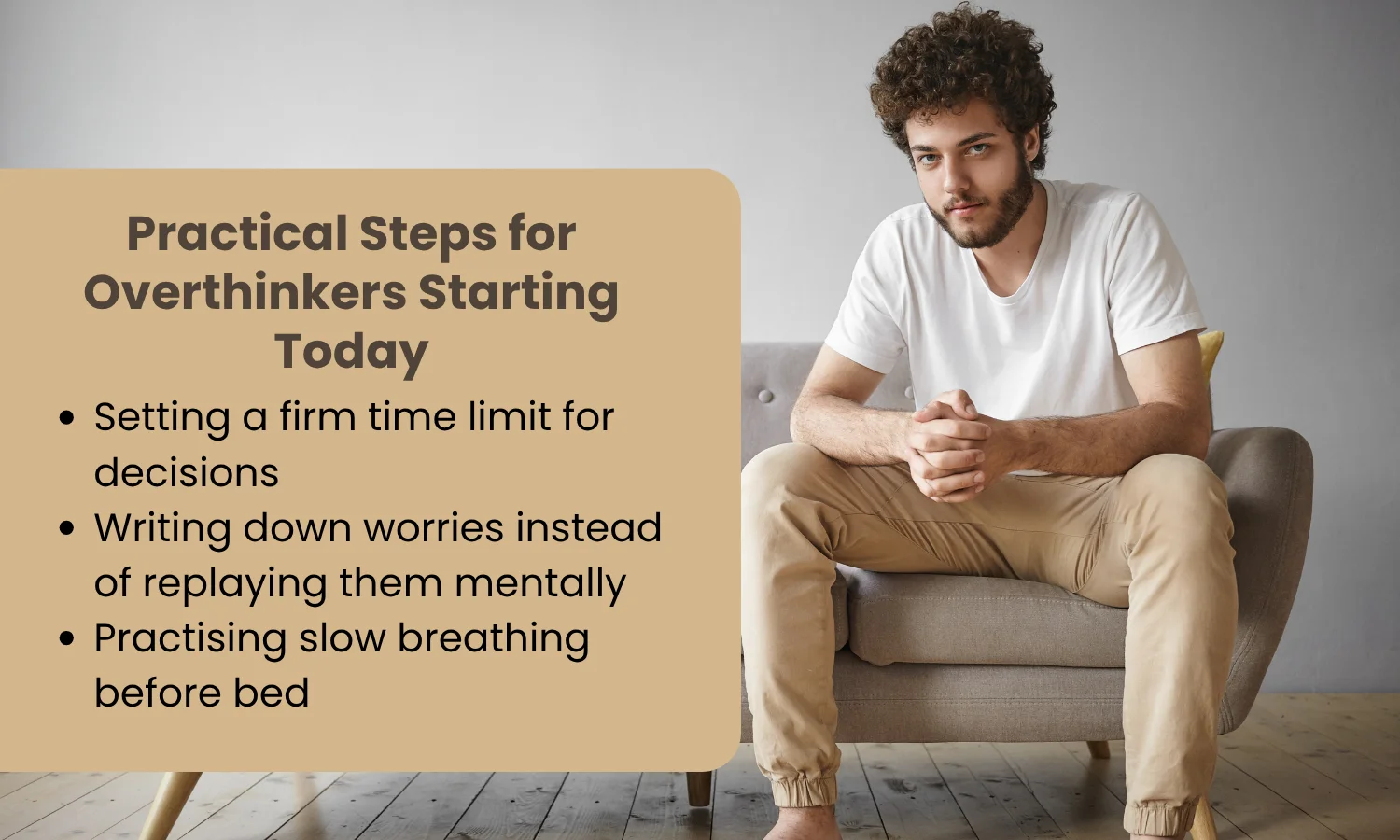
Change rarely happens through willpower alone. Overthinkers tend to respond better to structured, repeatable habits than to vague advice about relaxing. Here are some evidence-informed starting points for an overthinking mind:
- Setting a firm time limit for decisions
- Writing down worries instead of replaying them mentally
- Practising slow breathing before bed
Physical movement also plays a meaningful role. Even a short walk interrupts the mental loop by shifting attention outward, which gives the nervous system a chance to settle before the mind returns to its usual patterns.
Key Takeaways
- Overthinkers experience mental fatigue that often has no clear physical cause behind it.
- The “overthinker meaning” centres on repeated analysis that fails to produce resolution or relief.
- Racing thoughts at night frequently disrupt sleep, which then worsens the pattern the next day.
- Distinguishing ordinary worry from intrusive thoughts helps decide when professional support is needed.
- Structured daily habits interrupt negative thoughts more effectively than willpower or self-criticism.
Take the First Step With Coach Geeta
Founder and ontological coach, Geeta Ramakrishnan, popularly known as Coach Geeta, is the author of the Amazon bestselling book, “The Game of Change.” Through her book, she helps overthinkers build self-awareness, emotional resilience, and genuine calm.
If your thoughts feel heavy and endless, this is your moment to act. Book a coaching conversation with Coach Geeta today and take the first real step toward a focused mind, stronger relationships, and a more confident, purposeful life. You have carried this mental weight long enough, and a lighter, clearer version of you is well within reach.
FAQs
What is the difference between overthinking and normal thinking?
Normal thinking reaches a decision and moves forward, while overthinkers tend to revisit the same decision repeatedly without new information. The repetition itself, rather than the topic, is usually the clearest sign that thinking has crossed into an unhelpful pattern.
Are overthinkers more likely to struggle with anxiety?
Many overthinkers do experience anxiety alongside their thought patterns, since both involve an overestimation of risk and a difficulty settling uncertainty. Not every overthinker meets the criteria for an anxiety condition, but the overlap is common enough to warrant attention if the pattern feels persistent.
Can overthinking be unlearned over time?
Yes, with consistent practice, most overthinkers can reduce both the frequency and intensity of their thought loops. Building self-awareness, practising structured coping tools, and seeking coaching support when needed all contribute to lasting change over a period of weeks to months.
Why do overthinkers struggle more at night?
At night, external distractions disappear, and the mind has fewer demands competing for its attention, which allows unresolved worries and overthinking thoughts to surface more easily. This is why many overthinkers report their most intense racing thoughts happening right before sleep.