Overview
Anxiety and overthinking form a loop where worry fuels repetitive thought, and repetitive thought fuels more worry. Fear of uncertainty and ongoing stress often sit behind this pattern, sometimes deepening into an overthinking disorder or low mood over time. Learning practical anxiety coping strategies, alongside simple grounding practices, helps interrupt the cycle and restore a steadier, calmer state of mind.
Understanding the Connection Between Anxiety and Overthinking
Anxiety and overthinking rarely show up alone. Anxiety creates a sense of unease about something uncertain, and the mind responds by trying to think its way to safety. This produces the familiar loop of replaying conversations, rehearsing worst-case scenarios, and searching for reassurance that never quite arrives.
Coach Geeta, an ontological coach and author of “The Game of Change,” describes this pattern as the mind mistaking motion for progress. The thoughts feel active and urgent, yet they rarely produce a decision or a solution, only more fatigue.
How Stress Feeds the Cycle
Stress and overthinking are closely linked, since ongoing pressure at work or at home keeps the nervous system in a heightened state. In this state, even small decisions, such as replying to a message or planning a weekend, can trigger disproportionate mental effort. The body stays tense, sleep becomes lighter, and the mind keeps circling unresolved concerns late into the night.
Fear of Uncertainty at the Centre
Fear of uncertainty plays a defining role in this pattern. When the future feels unclear, whether in a career decision or a family matter, the mind tries to eliminate every unknown before it can feel settled. Coach Geeta’s coaching sessions often help clients see that certainty is rarely available in advance and that comfort with not knowing is itself a skill that can be built over time.
When the Pattern Becomes an Overthinking Disorder
For some people, this cycle becomes persistent enough to resemble an overthinking disorder, marked by constant worry, difficulty relaxing, and physical tension that does not ease even during rest. While it may not always carry a formal clinical label, it is a recognized pattern closely tied to generalized anxiety, and it deserves the same level of care and attention.
How to Deal With Anxiety Alongside Overthinking
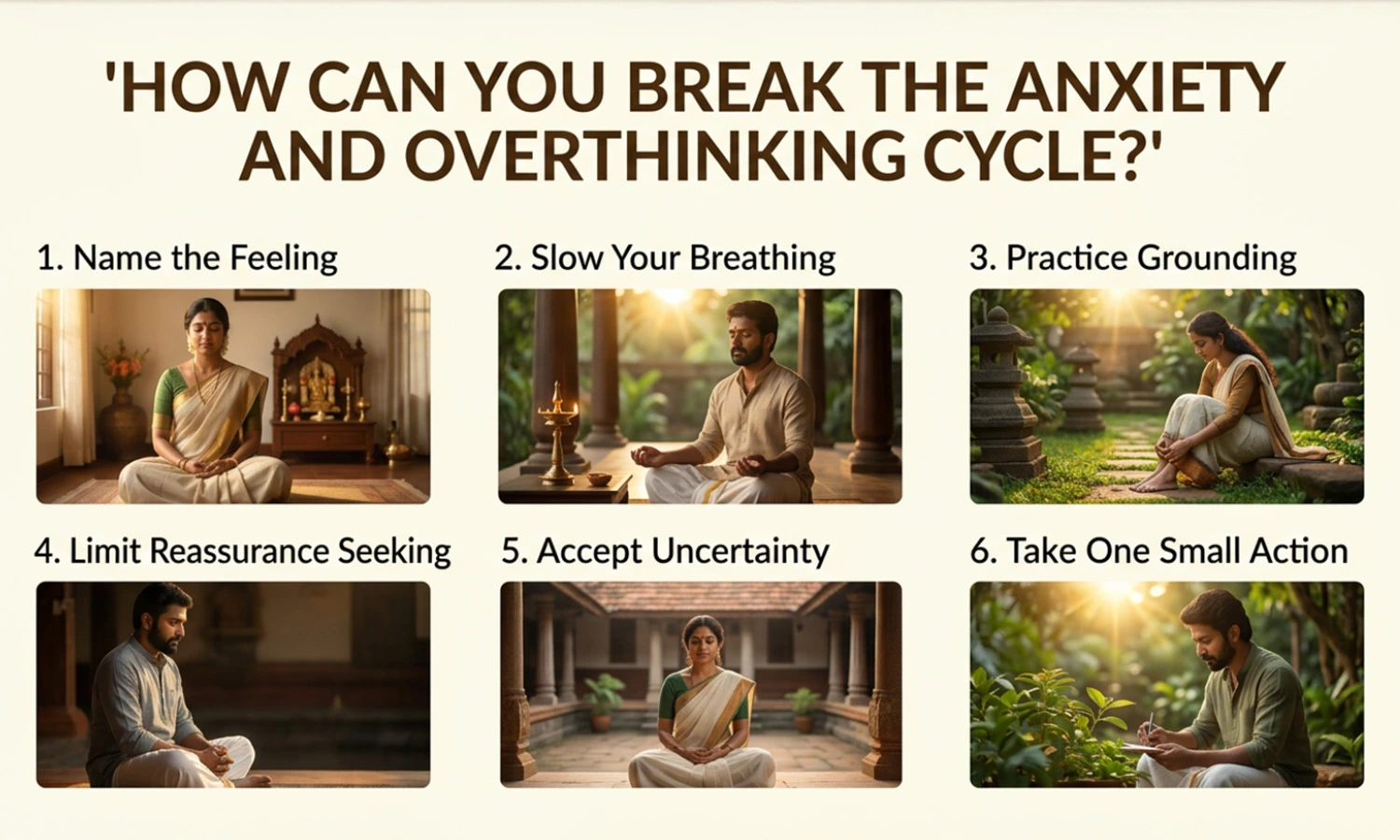
How to deal with anxiety effectively usually means addressing both the emotional wave and the mental loop it creates. A few practices that support both include the following.
- Naming the anxious feeling directly, rather than only analyzing the thought behind it
- Practicing slow, extended exhales to calm the nervous system
- Limiting reassurance-seeking, since it often reinforces the cycle instead of resolving it
- Scheduling a short, dedicated “worry window” each day to contain the spiral
These simple anxiety coping strategies work because they give the nervous system permission to settle instead of staying on alert.
How to Calm Your Mind From Overthinking
Calming your mind from overthinking often starts with the body rather than the mind. A short walk, a warm drink, or a few minutes of quiet breathing can lower the physical intensity that keeps thoughts circling. Once the body settles, the mind tends to follow.
Coach Geeta encourages clients to build a small evening ritual around this idea, helping them stop overthinking and relax before bed instead of carrying the day’s worries into their sleep.
Building Long-Term Calm
Anxiety and overthinking rarely disappear overnight, but with consistent, small practices and, where needed, guided coaching, the loop can loosen its grip. Coach Geeta’s book, “The Game of Change,” offers a structured path for readers who want to understand their own anxious patterns and build lasting calm rather than temporary relief.
Key Takeaways
- Anxiety and overthinking reinforce each other, so addressing only one rarely brings lasting relief.
- Stress and overthinking intensify when the nervous system stays alert well after the actual pressure has passed.
- Fear of uncertainty is often the hidden driver behind constant analysis and worry.
- Simple anxiety coping strategies, like scheduled worry windows and slow breathing, can interrupt the cycle quickly.
- Evening rituals that help you stop overthinking and relax protect both sleep quality and next-day clarity.
Calming the Mind and Tackling Anxiety
If anxious thoughts keep circling long after the moment that triggered them has passed, you do not need to manage them alone. Coach Geeta’s coaching sessions and transformational programs are designed to help you break this exact loop with steady, practical guidance. Pick up “The Game of Change” or book a session with Coach Geeta to start building a calmer, more settled mind.
FAQs
Why do anxiety and overthinking always seem to happen together?
Anxious feelings prompt the mind to search for certainty through repeated analysis, and that analysis keeps the anxious feelings active, creating a loop where anxiety and overthinking sustain each other.
What is one quick way to deal with anxiety in the moment?
Slow, extended exhales signal safety to the nervous system almost immediately, making them one of the simplest ways to deal with anxiety without any special equipment.
Can an overthinking disorder be managed without medication?
Many people manage an overthinking disorder through consistent coaching, grounding practices, and lifestyle changes, though a doctor should always be consulted for a proper evaluation if symptoms are severe.
How long does it take to feel calmer using these strategies?
Some anxiety coping strategies, such as slow breathing, bring relief within minutes, while deeper patterns often need several weeks of consistent practice or coaching to shift meaningfully.