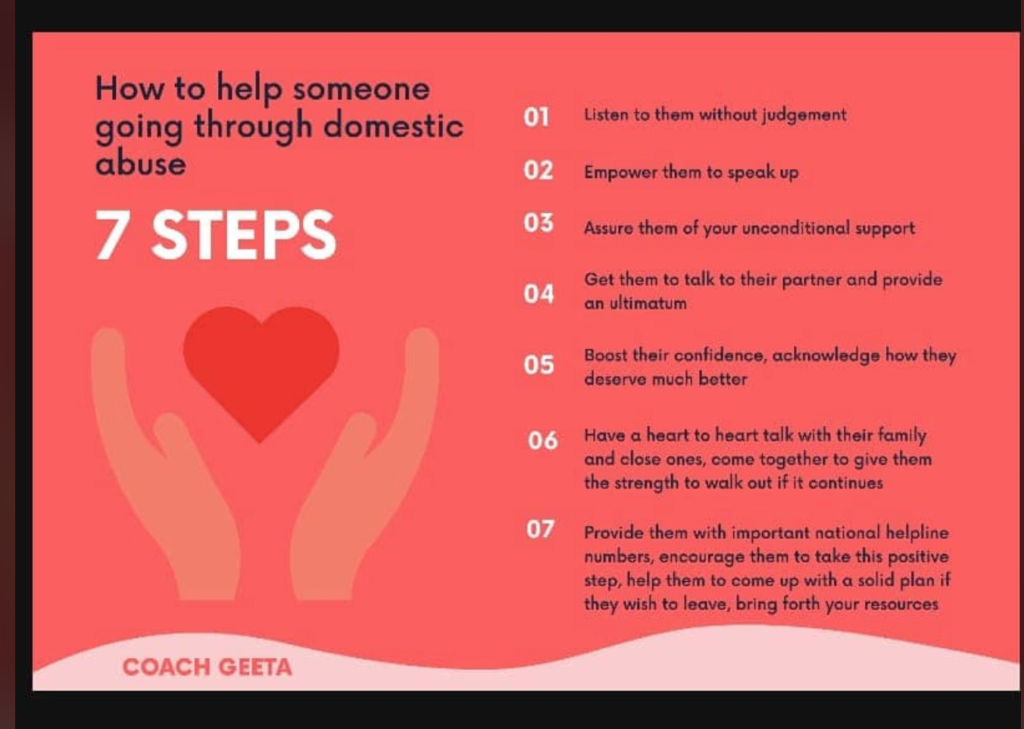
When do you Walk out of a Relationship..In a marriage relationship, like any other relationship, it is good to define your boundaries from the start. Like some things are a big NO NO. Any form of repeated physical abuse, even if followed by a sorry every time is a NO NO. Any form of emotional abuse is more harmful than physical abuse. Be it bullying or temper tantrums or repeated derogatory remarks with the intention of putting you down, where you begin to doubt your own capability and self-worth is a big NO NO. Once this abusive behavior becomes a pattern, over time the abuser may not even be aware of this pattern as much as the recipient who may tend to accept it. The aggressor is often weak and the abuse give them a false sense of power. They may often need help to come out of this pattern. You saying NO is the first best step. Seek professional help. If the abusive partner is not willing to take this matter seriously and unwilling to take consistent action, then walking out of the relationship, however difficult it may be, will help getting your dignity and confidence back.
Lord Ganesh
Lord Ganesh with his elephant head symbolizes awareness and focusing on this energy with the intend helps discriminate ego from self. In that sense, he is a lord of removal of obstacles. You can take it literally or in a philosophical sense, and it can work both ways. It is a matter of perception.
Ganesh Chaturti, like all Indian festivals follow the moon calendar and falls on the 4 th day of new moon in the month of Sharavan month.
On this occasion of Ganesh Chaturti I want to wash everyone more awareness, more happiness and peace!
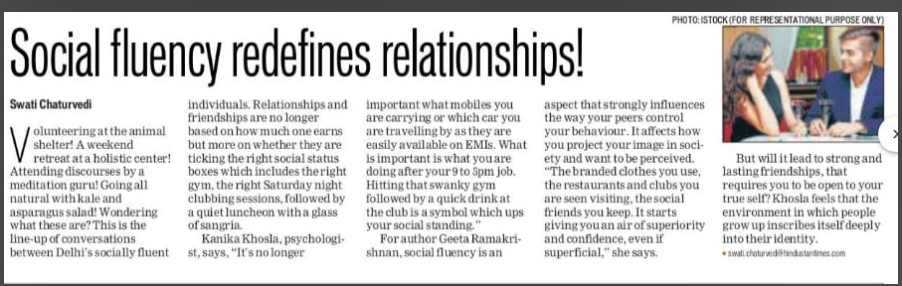
Social Fluency Redefines Relationships
Social fluency has redefined our connected world today, and for many of us it is now a part of our identity. In this article published in Hindustan Times , I share my views on this constantly evolving topic.

Social fluency strongly influences the way your peers can control how you think and behave. You give importance to what others think of you more than what you really are. It influences how you project your image in society and want to be perceived. The branded clothes you use, the restaurants and clubs you are seen visiting, the social friends you keep. It starts giving you an air of superiority and confidence, even if superficial. This glamour and glitz does the trick to help form relationships. But will it lead to a strong and lasting one, that requires you to be vulnerable and open to your true self?
Blog 33/52: Elephant in the Room
Blog 33/53
Address the Elephant in the Room
When your partner is angry, upset or sad, they sometimes just need a safe space to vent their frustration. They need your grounded presence, a shoulder to cry on. They are not looking for a solution to their problem, or your critical advice which often goes as ‘I told you so’. They want your patient ear, no retort, no judgement, no comments. Let your partner vent the frustration. If you are the unwitting victim to this anger and irritation, hear it out without reacting. Tell your partner you both can revisit this discussion with a calmer state of mind. Use that calm opportunity, often found by the next day, to check what triggered the anger. If hurtful words were used in anger, simply address it with an even tone, saying you do not appreciate such hurtful words. Often conversations in a calm frame of mind turn out to be more fruitful. And it is always better to address the elephant in the room at the appropriate time rather than sweep it under the carpet to buy temporary peace.
Coaching VS Counseling
In this extensive article for Medium, I map out the difference between coaching and counseling, the core essence of these two words, along with the approach followed by the two practices. Both help us brighten our outlook towards the world, and teach us how to deal with essential parts of our inner lives.
Ever wondered what is the difference between coaching and counseling? Here are four of them
Coaching and counseling, both germinate with the same premise. The presumption for both will always remain that every individual undergoes pain in their life in some form or the other. And that many individuals do not go to the bottom of the core problem and rather live with the wound unhealed — raw or camouflaged. This happens more unconsciously and many accept their problem as part of life and do not feel the need to seek help. Sometimes these often recurring problems are so entrenched into their daily way of living, that it seems normal. This is mainly due to the lack of awareness on what counseling and coaching are and what it has to offers and how it can help people. Some people also live in denial and do not want to accept they have a problem. The social stigma and acceptance level of going to a counselor or a coach, let alone a psychologist or a psychiatric is still very negative. This can lead to self-sabotage of some kind. At some point in their life, to desire a different result, they must allow themselves to become vulnerable, to seek help. After all, everything you want is on the other side of fear, as aptly said by Jack Canfield, an American author and motivational speaker who co-authored the Chicken Soup for the Soul series.
Mental illness like prolonged bouts of feeling sad or depressed for no apparent reason, where going through with your day to day activities becomes a challenge, or feeling suicidal requires immediate help and clinical treatment. On the other hand if you are surrounded with stress and don’t know how to handle it, like un-reconcilable differences or conflict in a relationship or at work, you feel stuck in life, you lack motivation and don’t know what the next better step in life is, or you are curious and want some help with introspecting life, what do you do? If you do decide to step out and seek help to help, would you go to a counselor or a life coach? The biggest difference in coaching and counseling is the difference in approaches. Life coaches focus on creating a new life path to achieve certain goals. They help you introspect and help you find your solutions. They focus on the now and what next. Whereas counselors focus on specific problems in hand and look into emotional resolutions to past problems to move forward, finding solutions to those specific problems, while making ‘healing’ as one of the main objectives. One must be aware of the many areas of overlap between these above methods of seeking help.
Let us explore more on the differences between coaching and counseling
Coaching helps you take action and Counseling enables you to cope\
You seek a life coach when you are surrounded with stress, feel stuck in life with a problem or an issue, not knowing how to handle it and feel frustrated in life, you have low self-confidence, you need motivation, you need to be a better version of yourself and need that push, you need help to reflect your next step, you are unhappy and unsatisfied in your job and maybe want to change your job or your profession, you are feeling low, you have a relationship issues, you want a better work-life balance, you want to improve your health but don’t know the next step and you need someone to handhold you, you procrastinate and waste time and need help in planning and organizing your life better.
Coaches focus on introspection and are action-oriented when it comes to resolving the issue. They believe in giving the clients problem-solving skills rather than specific solutions to a problem. It helps the client handle and successfully adapt to any other situation and stress the client may face in the future. They work with you to identify the problem, set goals to resolve the problems and create a path to achieve the goals.
Some situations which can help by going to a counselor are when you have addiction issues like smoking, alcohol, substance abuse, eating disorders like excessive eating or anorexia, physical or verbal abusive behavior, any phobias like fear of water or crowded places, feeling frustrated with others, suffered a traumatic experience, maybe a bereavement, or sometimes you are just feeling demotivated. Counselors encourage their clients to talk about their problems and help them cope with the problems that they are facing by finding solutions to those problems. They take you to your past, delve in the emotional turmoil, looking for links and solutions to your issues. Healing forms a big part of finding solutions. They also work with other coping mechanisms like communication skills, group support, and therapy to get better solutions for the problems at hand. This enables clients to either reduce or tolerate the stress or conflict in their lives. Broadly there are two types of coping mechanisms: active and avoidant. Counselors also guide clients on using adaptive coping mechanisms such as support, relaxation, physical activity or humour.
Feeling and thinking
A life coach assists one in thinking and introspection. And thinking is hard! This by itself is challenging. Thinking is encouraged to overcome a situation and to optimize potential. Counselors help one realize the deepest of the feelings. They support one with a lot of understanding and help one stay at peace.
Goal-centric vis-à-vis clarity-centric
Coaches are trained to help one see clearly where one is today and then move towards the goals. Counselors create a safe and supportive space to find out where one is tuck in their life and not able to liberate themselves.
Training and certification
Counselors have various master’s and doctorate degrees and they are licensed by their respective states too. Coaches obtain certification through an accredited program like the International Coaching Federation and there are no degree requirements. Though coaching training does consist of several weekends of in-person training along with online modules. Case studies are submitted for review. Counselors in the UK have extensive training in human emotions and thinking, followed by being a supervised trainee. However, anyone can legally designate themselves as a counselor or a coach in the UK. This is different in the United States, where it is not legal to call oneself a counselor without recognised training. In India, most counselors have a background in psychology. Hence it is important to ask one’s coach or counselor about their training.
We would also like to cover a few myths on this subject:
Myth 1
Coaching only focuses on the present and the future. Counseling exclusively focuses on the past.
Myth 2
Counselors offer advice and on what to do, whereas, coaches do not.
Summary:
Coaching helps people achieve their goals. The basic presumption itself of coaching is that coaching clients are in a healthy mental and physical space and are prepared to receive guidance and direction on how to achieve their goals. And hence the work involved is on getting inspired and motivated on planning, changing and updating.
Counselors create safe and supportive spaces so that one can explore questions like ‘where one is stuck’, ‘who one really is’ and ‘how to cope up with what one is facing in life’. Counselors help you identify problems and act as a solid support system to assist you in gaining strength.
Parenting
The joy of being a parent is something that cannot be explained but needs to be experienced. But it is also something that seriously requires your time, financial, physical and emotional commitment. My article in Femina lists down some of the ways in which you can manage your energies as a parent!
Being a perfect parent is a myth. Yet this is a constant endeavour as parents. To begin with, the decision to be a parent entails enormous responsibilities. As prospective parents, you need to give serious thought to the time, financial, physical and emotional commitment. Yet sometimes too many thoughts, ifs and buts, am I capable, and can we afford, does not work either. The joy of being a parent is something that cannot be explained but need to be experienced. You can never be prepared enough when your bundle of joy arrives and turns your world upside down.
With young children, you need to be high energy super-parents. You have to multitask, and be there for them and somehow magically manage your work, find time for yourself, your relationship and your social life. Young children depend on you for their physical needs and emotional support. It is worth investing in getting a perfect time management routine in place, with both parents chipping in.
Despite this juggling, often parents need some help and support. Enrolling the grandparents and friends or outsourcing help is usually a win-win formula. It can give you, as a parent, some free time for each other, to gather your sometimes chaotic and fast-paced life. This allows you to be fully available as parents, where you are more fun to be with rather than be stressed and in an angry mood.
When you are with your children, give them your 100 per cent attention. By attending office calls during family time, you are unconsciously sending the message that they are less important to you, while ironically, you are working for your family. The best parts of your childhood are not those expensive gifts your parents gave you; it is the time you spent together, the times you laughed and played together. Wouldn’t you want to provide the same to your children?\
If your life is more organised and disciplined, your children learn by example. Co-create the rules and boundaries together, enrolling the children in the process. Define the consequences of breaking the rules. It need not be severe. Missing the weekend out or washing the dishes perhaps. And follow through with it. Playing board games or doing a barbeque together is excellent family bonding exercises.
Your children learn from you. Empower them with ethical values like mutual respect and empathy. Teach them through example, by living it yourself. Engage them in social discussions and increasing their awareness. Allow them to make their mistakes and learn from it, nurturing them into mature young adults ready to transform a better tomorrow, a better world.
Online Content : Increase Visibility
Our content is always close to the heart, and is aimed at sending out a beautiful message to as many people as possible. In a world filled with ready availability of a plethora of content all over the internet, I provide useful insights and tips on helping your content reach as many people as possible, in this article by experts all over the world.
Below excerpts from Barndon’s article…
‘One of the most asked questions I receive is, “What’s the best way to get people to read your content in a crowded online world?” So what I did, is reach out to recent Entreprenuer.com content authors to gain their insight as they’ve already mastered their content marketing strategies.
The insider knowledge each content creator shares is magical. There’s no need to rewrite the book when there’s already a proven strategy that works. Enjoy their answers, and be sure to connect and follow them on their social channels as they can help you improve your authority and influence.’
READ AND LEARN FROM THE EXPERTS…
The simplest way to get people to read your content in a crowded online world is to be really clear on WHO you’re talking to… many books, articles and pieces of content get overlooked because the writer or publisher is trying to talk with too many different audiences and isn’t laser-focused on a particular niche or a segment. If you’re incredibly clear on who you’re talking to, that will lead to much more relevant information that those types of people are likely to seek out. If I feel like you really know and understand me and all of my problems and desires, I’ll pay attention to you and filter out those who don’t speak to me as directly.’ -Brandon Schaefer
My contribution to the article:
When you become vulnerable and show up as your authentic self, sharing your life learnings and experiences as against just posting inspirational quotes and sermons, you are more likely to draw people’s attention over hundreds of thousands of material floating in this crowded online world. People are looking for an emotional connection, wanting to know and see and hear how you live your life, handle your daily stress, what you eat to stay healthy perhaps and what you do to relax.
Blog 32/52 Partner or Clone
Blog 32/52:
What would it be like to marry a clone like partner, matching every way you think and feel and behave? Imagine you like the same music, same food, same movies, both aggressively career oriented, getting angry about the same things…you think life will be smooth and fun? Think again…
When you partner with someone loving and caring and with a different perspective, it helps you reflect your thoughts, to argue yet learn, to supplement each other’s growth. You learn openness and flexibility, both being important elements for your personal growth and in-turn enabling you to offer your confident solid presence in your relationship.
Elements of a successful relationship are when both partners have the space for personal growth, yet be able to support and contribute to each other’s growth and also thrive as a team, learning from each other’s strength and weakness.