• Skip to main content

The Game of Change

Geeta Ramakrishnan

  • About
  • Work With Me
  • Media
  • Book
  • Resources
    • Free
    • Premium
  • Blog
  • Connect

Geeta

How Do Wonder Women Manage Work and Family: Let’s Hear

March 17, 2020 By Geeta

Contributed to this article from the portal: Startup Talky, 8th Feb 2020

How do Wonder Women Manage Work and Family : Let’s Hear…By Shubam Kumar

Link: https://bit.ly/33bHNFM

“The dawn of globalization has opened up great avenues for business models and they are no longer perceived as male or female-dominated. Today, the emphasis is given to what an individual has to offer and how his/her ideas contribute to the bigger picture without any focus on gender.” This is India 2.0 for you! An era where abilities are preferred over academics and grind is preferred over gender classification. This is the India that our ancestors must have envisioned back then, although we are still far from the ultimate destination – women in our country have come a long, long way. From being a housewife or the breadwinner to becoming the ‘Queen of all trades, and master of all’ – this has been about the women in the country. Today, on the eve of international women’s day – let’s talk about the work life balance that’s an important issue among entrepreneurs whether it be men or women especially women who have to manage through the household chores as well, acing another responsibility to perfection seamlessly. It is tough being a women, indeed. Let’s see what the women in the house got to say on this.” ..Shubam Kumar.

Ms. Geeta Ramakrishnan, ontological coach and Author
Without any doubt its a challenge for our society. Planning your day, enrolling your family in the household chore,  learning to say ’No’, defining your boundaries and most important accepting love and care makes this an easy juggle.




Filed Under: Zen Success

Understanding the Difference Between Coaching and Counseling

March 17, 2020 By Geeta

My article from Entrepreneur.com  4th Mar 2020

Link: https://bit.ly/2vI6e1q    

Also appeared online: Flipboard : Link: https://bit.ly/2IqWcEO

Understanding the Difference Between Coaching and Counseling

If you do decide to step out and seek help to help, would you go to a counselor or a life coach?Coaching and counselling, both germinate with the same premise. The presumption for both will always remain that every individual undergoes pain in their life in some form or the other. And that many individuals do not go to the bottom of the core problem and rather live with the wound unhealed – raw or camouflaged. This happens more unconsciously and many accept their problem as part of life and do not feel the need to seek help. Sometimes these often recurring problems are so entrenched into their daily way of living, that it seems normal.

This is mainly due to the lack of awareness on what counseling and coaching are and what it has to offer and how it can help people. Some people also live in denial and do not want to accept they have a problem. The social stigma and acceptance level of going to a counselor or a coach, let alone a psychologist or a psychiatric is still very negative. This can lead to self-sabotage of some kind.

At some point in their life, to desire a different result, they must allow themselves to become vulnerable, to seek help. After all, everything you want is on the other side of fear, as aptly said by Jack Canfield, an American author and motivational speaker who co-authored the Chicken Soup for the Soul series.

Mental illness like prolonged bouts of feeling sad or depressed for no apparent reason, where going through with your day to day activities becomes a challenge, or feeling suicidal requires immediate help and clinical treatment. On the other hand if you are surrounded with stress and don’t know how to handle it, like un-reconcilable differences or conflict in a relationship or at work, you feel stuck in life, you lack motivation and don’t know what the next better step in life is, or you are curious and want some help with introspecting life, what do you do?  If you do decide to step out and seek help to help, would you go to a counselor or a life coach?

The biggest difference in coaching and counselling is the difference in approaches. Life coaches focus on creating a new life path to achieve certain goals. They help you introspect and help you find your solutions. They focus on the now and what next.

Whereas counselors focus on specific problems in hand and look into emotional resolutions to past problems to move forward, finding solutions to those specific problems, while making ‘healing’ as one of the main objectives.  One must be aware of the many areas of overlap between these above methods of seeking help.

Let us Explore More on the Differences Between Coaching and Counselling:

Coaching Helps You Take Action and Counselling Enables You to Cope:

You seek a life coach when you are surrounded with stress, feel stuck in life with a problem or an  issue, not knowing how to handle it and feel frustrated in life, you have low self-confidence,  you need motivation, you need to be a better version of yourself and need that push, you need help to reflect your next step, you are unhappy and unsatisfied in your job and maybe want to change your job or your profession, you are feeling low, you have a relationship issues, you want a better work-life balance, you want to improve your health but don’t know the next step and you need someone to handhold you, you procrastinate and waste time and need help in planning and organizing your life better.

Coaches focus on introspection and are action-oriented when it comes to resolving the issue. They believe in giving the clients problem-solving skills rather than specific solutions to a problem. It helps the client handle and successfully adapt to any other situation and stress the client may face in the future. They work with you to identify the problem, set goals to resolve the problems and create a path to achieve the goals.

Some situations which can help by going to a counselor are when you have addiction issues like smoking, alcohol, substance abuse, eating disorders like excessive eating or anorexia, physical or verbal abusive behavior, any phobias like fear of water or crowded places, feeling frustrated with others,  suffered a traumatic experience, maybe a bereavement, or sometimes you are just feeling demotivated. Counselors encourage their clients to talk about their problems and help them cope with the problems that they are facing by finding solutions to those problems. They take you to your past, delve in the emotional turmoil, looking for links and solutions to your issues. Healing forms a big part of finding solutions. They also work with other coping mechanisms like communication skills, group support, and therapy to get better solutions for the problems at hand. This enables clients to either reduce or tolerate the stress or conflict in their lives. Broadly there are two types of coping mechanisms: active and avoidant. Counselors also guide clients on using adaptive coping mechanisms such as support, relaxation, physical activity or humour

Feeling and Thinking

A life coach assists one in thinking and introspection. And thinking is hard! This by itself is challenging. Thinking is encouraged to overcome a situation and to optimize potential. Counselors help one realize the deepest of the feelings. They support one with a lot of understanding and help one stay at peace.

Goal-centric vis-à-vis Clarity-centric:

Coaches are trained to help one see clearly where one is today and then move towards the goals. Counselors create a safe and supportive space to find out where one is tuck in their life and not able to liberate themselves.

Training and Certification:

Counselors have various master’s and doctorate degrees and they are licensed by their respective states too. Coaches obtain certification through an accredited program like the International Coaching Federation and there are no degree requirements. Though coaching training does consist of several weekends of in-person training along with online modules. Case studies are submitted for review. Counselors in the UK have extensive training in human emotions and thinking, followed by being a supervised trainee. However, anyone can legally designate themselves as a counselor or a coach in the UK. This is different in the United States, where it is not legal to call oneself a counselor without recognised training. In India, most counselors have a background in psychology. Hence it is important to ask one’s coach or counselor about their training.

We Would Also Like to Cover a Few Myths on This Subject:

Myth 1

Coaching only focuses on the present and the future. Counselling exclusively focuses on the past.

Myth 2

Counselors offer advice and on what to do, whereas, coaches do not.

Summary:

Coaching helps people achieve their goals. The basic presumption itself of coaching is that coaching clients are in a healthy mental and physical space and are prepared to receive guidance and direction on how to achieve their goals. And hence the work involved is on getting inspired and motivated on planning, changing and updating.

Counselors create safe and supportive spaces so that one can explore questions like ‘where one is stuck’, ‘who one really is’ and ‘how to cope up with what one is facing in life’. Counselors help you identify problems and act as a solid support system to assist you in gaining strength.


Filed Under: Emotions

Blog 9/52 : Why is it important to have solid core values?

March 5, 2020 By Geeta

BLOG 9/52

Why is it important to have solid core values?

The body’s spine and skeletal structure forms its core support. Similarly we need a set of values with forms our core and dictates how we think, act, react and behave. It helps us connect with the others in this society. Many times we unconsciously pick up values from our parents, friends and school. Values like honesty, respecting elders, discipline, kindness, appreciation, perseverance.

Values gets planted in our heads, operating subconsciously, dictating our behavior. Often as we grow up we get so caught-up with our daily mindless living, that we may have kept some of these values and let go of some of them.

Give a pause and a thought. What are the core values that govern your life? Revisit them and articulate them. Give them a new definition, a new life. Leverage your values to your advantage.

Growth happens from within…


Filed Under: Zen Success

Times of India : How I Start my Day

February 29, 2020 By Geeta

My article from The Times of India, 16th Feb 2020

How I Start my Day

http://timesofindia.indiatimes.com/life-style/health-fitness/de-stress/how-i-start-my-day/articleshow/74130661.cmsIf you are a night owl, and that works for you, it’s great. There’s no reason to change. But for me, switching from being a night owl to an early riser has been godsend. It has helped me in so many ways that I’d never go back. I like to get up early in the morning and beat the sun and the birds to it. I ban all electronics, social media, email and phone calls for a set amount of time. Instead, I read a book or magazine, go for a walk, or simply stare out and daydream. Being an OCD planner, I spend 15 minutes every morning to prioritise and plan my day with breathing time in-between. I am mindful of the surprises that crop up. Being curious, introspecting and learning from mistakes helps me navigate the changes through the day with a positive attitude, and sometimes, these changes work better than what I had planned. Here are 4 habits for a fulfilling day:

* Start your day with a big smile, count your blessings.

* Once in a while, pause from your busy life and focus on your breathing.

* Charge your mobile phone in the room next to your bedroom.

Geeta Ramakrishnan

Ontological coach and author


Filed Under: Zen Success

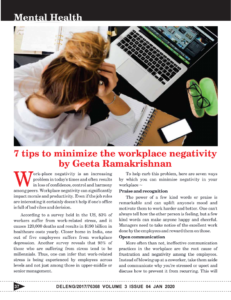
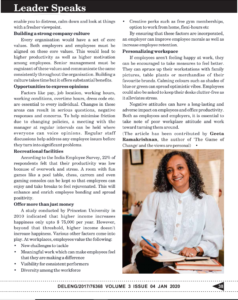
7 Tips to Minimize the Workplace Negativity

February 29, 2020 By Geeta

Article printed in the Jan 2020 issue :The Truth One magazine

7 Tips to minimize the workplace negativity

Filed Under: Brains and Science

Couplepreneurs Share Their Business, Love & Success Mantra

February 29, 2020 By Geeta

An article from Entrepreneur.com

https://www.entrepreneur.com/slideshow/346603

#5 Couplepreneurs Share Their Business, Love & Success Mantra

Couple-preneur might have become a popular term recently referring to a couple running a company today, but you better not mistake it for a new trend. Dig into history and you will realise how this has been a practice for ages now.

But when partners can have their differences, imagine when life-partners combine hands. Can business and pleasure work together? While many might find it tricky, Entrepreneur India spoke to five couple entrepreneurs to get an idea. These wonderful business minds, wake up together, work together, eat together and build a company together.

Geeta and Ramesh Ramakrishnan (Transworld Group)

Life Partners Turn Business Partners:

Love, at first sight, is a real deal, at least in the case of Geeta and Ramesh Ramakrishnan. They were young and madly in love and wanted to grow old and build a life together.

“It was but natural that I took interest in his business and chose an area where I could flourish. He is a creative thinker and I am the ODC planner. It is a good combination. We balance each other,” said Geeta.

Pros and Cons of Working Together:

Thousands people have a thousand opinions, many told the couple that working together in the same business causes cracks in the marriage. However, they feel it contributes to a stronger marriage, especially if you know and maintain your boundaries.

“We have learnt to respectively agree to disagree and still go ahead. It helps us have healthy discussions, debates and objectively analyze problems and come up with creative solutions. It took us years to perfect this act. We fight to glory at times. But somewhere it is an unwritten rule to vomit all the issues and clear it out of our system, however tough and difficult it may seem at that time,” she said.

Advice to Couples:

Spend time in discussing and deciding how you will split your time commitments between your relationship and professional commitments. Prioritizing and splitting the home chores helps in smoothing the edges.

“Transcend ego from self-importance into self-esteem. A relationship is a game of give and take. Give from your heart, not from weakness. Define your boundaries and know when a firm ‘NO’ is your friend. Mutual respect is an important core value to have. Believe that your spouse is as intelligent as you,” she said.

Common Mistakes:

Bringing your work disagreement in the boardroom or bedroom, do not allow your inflated ego to lead the conversation.

“Ego narrows your focus into what you think is right. When in the office, be mindful of your language and tone and use tact over your temper or in your bedroom, it robs you of a good night routine,” she shares.

Filed Under: Zen Success

Blog 8/52 : The Power of Breathing

February 29, 2020 By Geeta

The Power of BREATHING

Christina Zelano, a neurologist conducted experiments in breathing which confirmed that breathing stimulates areas in our brain connected to smell, memory, learning, emotion and behavior. For example, when we are stressed, our breath is shallow and we breath fast. This process actually helps us block our emotion, and helps us react instantaneously to the stress, without a thought. This is a protective mechanism of our brain. But we have made being in stress a way of life, a habit that seems normal and acceptable. We react more than act, often without analyzing the situation, leading to rash reactions which we often regret after. Here we are in a shallow breathing’ mode.

Conscious deep slow breathing mode on the other hand, makes us alert, helps strengthen our memory and learning ability , opening us to an accepting and learning brain. It helps us connect emotionally to people, and this ability to connect to others is where growth mindset takes place.

Deep slow breathing also makes our body more alkaline whereas stress makes our body more acidic. An alkaline body helps reversal of anti- inflammatory life-style diseases like Diabetes, Cardiac Disease, Alzheimer’s and Obesity, to state a few.

#selfhealing #breathing #powerofbreathing #selfhelp #breakingfree

Filed Under: Body and Language

Blog 7/52 : Language is Generative.

February 29, 2020 By Geeta

Blog 7/52 : Language is Generative.

Language is generative. It generates a reaction in the other person based on their understanding of the words we use, the tone with which we deliver the words, along with the body language while using them. This context makes it all the more important to choose our words wisely.

For example I can say with a nasty tone and making that scrunched up face, ‘Why did I wear this tie today’? Or I can say with a smile, ‘You know what, this tie goes well with my pink shirt’… Which do you think is more acceptable way of communication, making the other person more open to your suggestion? If you want to connect with people, building trust is an important aspect.

You can have a different perspective and still agree to disagree, debate instead of argue and still make the other person feel heard. Listening is another important skill that helps. What does active listening mean? Giving your full attention, waiting for the other person to complete their sentence and not jumping to judge. The process of cleverly choosing the words along with and good listening skills becomes important tools to connect, to build trust, to by open, to be flexible and together creative new possibilities.

‘Progress is impossible without change and those who cannot change their minds cannot change anything’. George Bernard Shaw


Filed Under: Body and Language

  • « Go to Previous Page
  • Page 1
  • Interim pages omitted …
  • Page 15
  • Page 16
  • Page 17
  • Page 18
  • Page 19
  • Interim pages omitted …
  • Page 24
  • Go to Next Page »
  • Facebook
  • Twitter
  • Instagram
  • LinkedIn
  • YouTube
  • Connect

The information on this website is not intended to be a substitute for professional health or personal advice.
Always seek the advice of a qualified professional for medical conditions.


Copyright © 2026 · Geeta Ramakrishnan