• Skip to main content

The Game of Change

Geeta Ramakrishnan

  • About
  • Work With Me
  • Media
  • Book
  • Resources
    • Free
    • Premium
  • Blog
  • Connect

Emotions

Mindfulness for Change: How Presence Rewires Your Life

July 15, 2026 By Geeta

We spend most of our lives somewhere other than the present. Studies suggest people pass roughly ninety five percent of their time replaying the past or worrying about the future. That mental absence quietly blocks growth. Mindfulness for change is the practice of returning to now, where real choices are actually made. When you are present, you can finally see your patterns clearly and choose a different response. This article explains how mindfulness for change works and how to weave it into ordinary days.

Why Mindfulness for Change Matters

When your mind is stuck in the future, you live the same imagined moment over and over while missing the real one in front of you. No one can predict exactly what will happen, so rehearsing it only fuels anxiety.

Mindfulness for change interrupts that loop. By bringing attention back to the present, you create a gap between a trigger and your reaction. In that gap lives the freedom to choose, which is the whole point of present moment awareness.

Present Moment Awareness in Everyday Tasks

You do not need a meditation cushion to practice. Try taking a new route to work and noticing the people, the trees, and the flowers along the way, instead of mentally rehearsing your meeting.

This simple shift trains present moment awareness. Being observant pulls you into the now, and curiosity becomes a doorway to mindful living. The more often you practice, the more natural this presence feels.

Mindful Living Through the Senses

Cooking is an excellent mind and body exercise. The touch, smell, and colours of the ingredients connect your body with your mind and fire up your imagination of how the meal will taste.

Activities that engage the senses anchor you in the present and support mindful living. They turn routine chores into small moments of focus, which steadily builds the mental clarity that change requires.

Breathing as a Gateway to Self Awareness

Slowing your breath and observing your thoughts come and go is a form of meditation in itself. You can sit comfortably in a chair, keep your back straight, and simply watch your breath. Researchers at Northwestern University found that the rhythm of breathing shapes activity in brain regions tied to emotion and memory.

This gentle practice deepens self awareness. As you notice your thoughts without grabbing them, you begin to understand your own patterns. Self awareness is the foundation on which mindfulness for change is built.

From Mental Clarity to Emotional Balance

A present mind is a calmer mind. When stress drops, you gain time and energy, which increases your ability to see problems as opportunities. This is how mental clarity translates into better decisions.

Over time, mindfulness for change produces emotional balance, the steady inner state that lets you respond rather than react. Keep returning to the present, keep observing your breath, and that balance will grow stronger with practice.

Micro Mindfulness for Busy Days

You do not need an hour to practice mindfulness for change. Micro practices fit into ordinary moments. Take three slow breaths before answering a message. Feel your feet on the floor while the kettle boils. Notice the colours around you at a red light.

These tiny pauses build present moment awareness without disrupting your schedule. Repeated through the day, they train the mind to return to now, which is exactly where mindful living begins.

Common Misconceptions About Mindfulness

Many people think mindfulness means emptying the mind or sitting cross legged for hours. Neither is true. Slowing your breath and watching your thoughts come and go, even while seated in a chair, is a complete practice in itself.

Another misconception is that you must feel calm immediately. Mindfulness for change is about noticing, not forcing. The goal is self awareness, the ability to observe your patterns clearly, which naturally leads to greater mental clarity over time.

How Mindful Living Improves Decisions

When you are present, you create a gap between a trigger and your reaction. In that gap lives choice. Instead of snapping back out of habit, you can pause and choose a wiser response.

This is how mindfulness for change improves real decisions. As stress drops, your thinking clears, and problems start to look like opportunities. The steady result is emotional balance, the calm centre from which better choices flow

Bringing Mindful Living Into Ordinary Moments

Mindfulness for change does not require hours of silence or a special room. It can live inside the tasks you already do. Washing dishes, walking to the car, or drinking a glass of water can each become a moment of present moment awareness if you give them your full attention. The point is not to add more to your day but to be more present in what is already there.

This matters because a scattered mind tends to repeat old patterns automatically. When you slow down and notice what you are doing, you create a small gap between a trigger and your response. In that gap, choice becomes possible. That is where real change begins, and it is why mindful living supports every other habit you are trying to build.

Try anchoring your attention to your breath for the length of three slow inhales and exhales whenever you move between tasks. This brief reset builds mental clarity and restores emotional balance during a busy day. Repeated often, these short pauses deepen self awareness and make calm a more familiar state rather than a rare one.

FAQs

Mindfulness for change helps by creating a pause between a trigger and your response. In that pause you can choose a new action instead of repeating an old pattern. A regular mindfulness practice builds the self awareness that real change requires.

Present moment awareness means giving full attention to what you are doing right now. You can practise it during ordinary tasks like walking or eating. This simple mindful living habit builds mental clarity and steadies your emotional balance.

Yes. A consistent mindfulness practice calms a scattered mind, which improves mental clarity and supports emotional balance. By noticing thoughts without reacting, you build self awareness and respond to life with more steadiness.

Even a few minutes a day helps. Short, frequent moments of present moment awareness matter more than rare long sessions. Mindfulness for change grows through regular mindful living, so consistency is the goal rather than duration.

Take the Next Step

Mindfulness for change deepens with regular practice and gentle guidance. If you would like support building a mindful routine, visit https://coachingwithgeeta.com/book-a-session/ to learn more and book a session

Filed Under: Emotions

Personal Growth and Change: Building Confidence From Within

July 15, 2026 By Geeta

Real confidence is not loud. It is the quiet certainty that you can handle whatever comes, and it is built from the inside out. Personal growth and change are the path to that certainty. When you focus on inner growth rather than outer approval, self improvement becomes steady and self development feels less like pressure and more like progress. This article explores how to grow your confidence from within and make personal growth and change a lasting part of who you are.

Personal Growth and Change Start With Looking Within

Introspection is where transformation begins. By looking within, you see which beliefs and habits help you and which quietly hold you back. You can do this on your own, with a trained coach or counsellor, or through guided meditation.

This honest self review is the root of inner growth. Once you can name what is no longer working, you gain the power to change it. Personal growth and change always begin with this kind of clear seeing.

Emotional Growth Comes From Letting Go

Holding on to old resentments and blocks drains your energy and keeps you guarded. Letting go of that baggage introduces new energy into your system, a feeling of joy and openness that makes room for emotional growth.

When you release what weighs you down, your nervous system relaxes and your perspective widens. This is where self improvement turns from a struggle into a natural unfolding. Emotional growth is the soil in which confidence quietly takes root.

Confidence Building Through Small Brave Actions

Confidence building does not require a single dramatic leap. It grows from small brave actions repeated over time, such as learning a new skill, speaking up, or trying something unfamiliar. Each completed step tells your brain that you are capable.

Set a goal you can review weekly and forgive yourself for the off days instead of quitting. This steady rhythm is how confidence building becomes self development. Personal growth and change reward consistency far more than intensity.

Mistakes Strengthen Self Development

Dr. Carol Dweck of Stanford University found that the brain forms deeper neural connections when you make mistakes and learn from them, rather than repeating tasks you already master. Mistakes are not proof of failure, they are part of the design of growth.

Welcoming errors as feedback is a core skill of self development. It frees you to experiment, and experimentation is where life transformation happens. Personal growth and change accelerate when you stop fearing the wrong move.

From Inner Growth to Lasting Life Transformation

Inner growth eventually shows up in the outer world. As your confidence rises, your relationships, work, and health often improve, because a calmer and more open mind sees more opportunities. This is how quiet inner growth becomes visible life transformation.

Stay patient with yourself. Personal growth and change are not a destination you reach once, but a practice you return to. Keep looking within, keep letting go, and keep taking small brave steps, and your confidence will continue to deepen.

Why Comparison Slows Personal Growth and Change

Constant comparison is one of the biggest blocks to confidence. When you measure yourself against others, you borrow their standards and lose sight of your own progress. Personal growth and change ask you to compare yourself only with who you were yesterday.

This shift protects inner growth. Instead of chasing someone else’s milestones, you focus on your own steady self development. The result is a calmer, more grounded confidence that does not depend on outside approval.

Daily Practices That Support Inner Growth

Inner growth is built through small, repeatable practices. A few minutes of slow breathing settles the nervous system. A short reflection at day’s end helps you notice what you learned. One brave action, however small, tells the brain that you are capable.

These practices keep emotional growth moving. Done consistently, they turn personal growth and change from an occasional effort into a quiet daily rhythm, and that rhythm is where lasting confidence is born

Turning Setbacks Into Self Development

Setbacks are not the opposite of progress, they are part of it. Dr. Carol Dweck of Stanford University found that the brain forms deeper connections when you learn from mistakes rather than avoiding them. A setback, handled well, becomes raw material for self development.

When something goes wrong, ask what it is teaching rather than what it proves about you. This reframing keeps confidence intact and keeps personal growth and change moving forward, even on hard days. Life transformation is built from many recovered stumbles.

How Confidence Building Reinforces Lasting Change

Confidence is not a trait you either have or lack. It is built through evidence you give yourself by following through on small promises. Each time you do something slightly outside your comfort zone and survive it, your brain records proof that you can handle more than you assumed. This is why confidence building works best in small steps rather than giant leaps that overwhelm you.

As confidence grows, personal growth and change become easier because fear takes up less space. You stop needing certainty before you act. You begin to trust that even if a new approach does not work, you will learn something useful and adjust. That trust is the foundation of emotional growth, and it is what allows inner growth to continue long after the first wave of motivation has faded. Steady self development, repeated over months, is what turns a hopeful start into durable change.

FAQs

Confidence building and personal growth and change reinforce each other. Each small brave action gives your brain proof that you can cope, which fuels further self development. As confidence grows, fear shrinks and inner growth becomes easier.

Build confidence by keeping small promises to yourself and acting slightly outside your comfort zone. Each kept promise becomes evidence of capability, supporting emotional growth and inner growth. Steady self improvement, repeated over time, turns hope into lasting change.

Comparison slows personal growth and change because it shifts focus to others instead of your own progress. Measuring yourself against your past self is more useful, since it highlights real self development and protects your confidence building.
ed together

Yes. Setbacks often drive the deepest personal growth and change, because working through mistakes strengthens both learning and resilience. Treated as feedback rather than failure, setbacks support emotional growth and lasting life transformation.

Take the Next Step

Personal growth and change feel lighter with steady support and a clear path. If you would like guidance on building confidence from within, visit https://coachingwithgeeta.com/book-a-session/ to learn more and book a session.

Filed Under: Emotions

Personal Growths and Change: How Adaptability Sets You Free

July 15, 2026 By Geeta

Personal Growths and Change

The people who stay vibrant across decades share one quality above all others. They adapt. Personal growth and change are not reserved for the young or the lucky. They are skills anyone can practice, and adaptability is the master skill that makes them possible. When you stay flexible and open, self improvement stops feeling like a chore and becomes a natural part of living. This article shows how adaptability drives personal growth and change, and how to build it into your everyday life.

Why Adaptability Drives Personal Growth and Change

Humans have survived through the ages by adapting, which is the essence of evolution. The same principle applies to your own life. Those who keep learning and adjusting continue to grow, while those who resist tend to stagnate.

Adaptability is the engine of life transformation. It lets you meet new situations with curiosity instead of dread. Each time you adjust to something unfamiliar, you reinforce your capacity for personal growth and change.

A Living Example of Self Improvement at Any Age

Consider an elderly woman in her late nineties who grew up in a world with strict rules about how women dressed and behaved. Rather than judging her great grandchildren for their modern clothes and torn jeans, she asks about the styles, admires the colours, and delights in the trends.

Her flexibility is the source of her happiness. This is self improvement in its purest form, a willingness to stay curious about a changing world. It proves that self development has no expiry date and that inner growth can continue across a lifetime.

Let Go of Baggage to Make Room for Inner Growth

Old resentments and fixed beliefs weigh you down. Letting go of this baggage introduces fresh energy into your system, the kind that feels like joy and possibility. This release is essential for genuine inner growth.

Personal growth and change ask you to be vulnerable and to release the fear of an unknown future. When you stop guarding old wounds, your attention is free to notice new opportunities, and emotional growth follows naturally.

Mistakes Are the Raw Material of Self Development

Dr. Carol Dweck of Stanford University found that neural connections deepen when you make mistakes and learn from them rather than repeating what you already do well. Mistakes are not setbacks, they are signposts to new methods and ideas.

Treat every error as part of your self development. Trying new approaches and thinking beyond the obvious is a reliable sign of progress. This mindset turns ordinary effort into steady personal growth and change.

Build Confidence Through Small, Brave Steps

Confidence building does not require a dramatic leap. It grows from small brave steps taken consistently, such as learning a new skill, taking a different route, or trying an unfamiliar activity. As Mahatma Gandhi suggested, you can choose to become the change you wish to see.

Personal growth and change reward patience and openness. Stay flexible, release what no longer serves you, and keep taking small steps. Over time, self improvement and emotional growth compound into a richer, more confident life.

Curiosity Is the Engine of Self Development

Curiosity keeps personal growth and change alive. When you stay genuinely interested in new ideas, people, and trends, learning feels natural rather than forced. The elderly woman who asks her great grandchildren about their clothes and styles models this perfectly, because her curiosity is the source of her happiness.

You can practice curiosity in small ways. Notice the details on a familiar route, ask better questions, or try an activity outside your usual range. Each act of curiosity feeds self development and keeps the mind open to life transformation.

How to Notice Personal Growth and Change in Yourself

Growth is often quiet, so it helps to track it. Set a goal you can review weekly, and note what felt easier than before. Watch for moments when you respond calmly to something that once upset you, or when you try something new without dread.

These small signals are real markers of personal growth and change. Recognising them builds confidence, and confidence building fuels the next round of self improvement. Progress you can see is progress you will continue.

Letting Go to Make Room for Emotional Growth

Old resentments and fixed beliefs quietly drain your energy. Letting go of that baggage introduces fresh energy into your system, a feeling of joy and possibility that makes space for emotional growth.

This release is not about forgetting the past, but about loosening its grip. As the weight lifts, your attention is freed to notice opportunities, and inner growth follows. Personal growth and change always have room to continue when you keep setting down what no longer serves you.

Turning Daily Life Into a Path of Self Improvement

Personal growth and change do not require dramatic gestures. They grow from ordinary choices repeated with intention. Taking a new route, trying an unfamiliar dish, or starting a short conversation with someone new all activate different parts of the brain. These small acts of curiosity keep your mind flexible and feed steady self improvement without demanding a complete overhaul of your life.

The people who change most are often those who stay open rather than those who try hardest for a brief burst. Openness lets new information reach you, and new information is what makes inner growth possible. When you let go of the need to be right and choose to learn instead, you create space for genuine self development. Over time these quiet choices compound into real life transformation that feels earned rather than forced.

FAQs

Personal growth and change mean steadily becoming more capable, aware, and adaptable over time. It is less about dramatic events and more about consistent self improvement, where small daily choices lead to genuine inner growth and lasting life transformation.

Start with curiosity and small new actions, such as trying an unfamiliar task or route. These steps keep the brain flexible and feed self development. Personal growth and change have no age limit, because the brain stays adaptable throughout life.

Self improvement often focuses on specific skills or habits, while self development is the broader growth of who you are, including emotional growth and mindset. Both support personal growth and change and work best when practised together

Signs of inner growth include reacting more calmly to setbacks, staying curious, and letting go of old grudges. If you handle change with more ease than before, that is real personal growth and change in action

Take the Next Step

Personal growth and change unfold faster with steady encouragement and a clear direction. For personal guidance on your journey, visit https://coachingwithgeeta.com/book-a-session/ to learn more and book a session.

Filed Under: Emotions

Habit Change Made Simple: Rewire Your Daily Routine

July 15, 2026 By Geeta

Habit Change

Most people try to force habit change through willpower alone, then blame themselves when it fails after a few weeks. The smarter path is to understand how habits are built in the brain and to work with that system. Habit change is not about being harder on yourself. It is about repetition, awareness, and a routine you can actually keep. This guide breaks down habit formation, the art of breaking bad habits, and the simple tools that make new behaviour stick.

How Habit Formation Works in the Brain

A habit forms when the same neural connections fire together repeatedly until they grow strong. Once a behaviour is well practiced, the brain moves it to a place where it runs almost involuntarily, like walking or riding a bicycle. This is the science of habit formation.

The catch is that this process does not judge whether a habit helps you. Many daily habits were learned in childhood and quietly run in the background even when they no longer serve you. Effective habit change starts by noticing these automatic patterns.

The First Step in Habit Change Is Awareness

You cannot change what you cannot see. Looking within lets you spot the daily habits that hold you back. You can do this through honest introspection, by working with a coach, or through guided meditation, with many apps available to help.

Once a habit that does not work is identified, real behavior change becomes possible. Awareness turns an invisible routine into a clear target, and a clear target is something you can actually adjust.

Breaking Bad Habits Without Punishing Yourself

Breaking bad habits is rarely instant. You replace the old behaviour by practicing a new one until it forms its own strong pathway. Your first attempt may not work, and that is fine, because you can simply try a more effective approach.

It is okay to be lazy for a day or two. Just notice it, and pick up where you left off rather than abandoning the goal. Self punishment slows habit change, while gentle persistence speeds it up.

Habit Tracking and Routine Building That Last

Structure makes new behaviour easier to hold. Set a one month goal and review it weekly, then set the next month’s goal when the first is done. This rhythm of habit tracking gives your brain visible progress, which keeps motivation alive.

Routine building also benefits from small commitments that raise the stakes. Paying in advance for a six month block of training sessions, for example, is a practical motivator that helps you continue. The point is to design daily habits that nudge you forward automatically.

Look Deeper When a Habit Will Not Budge

Sometimes a stubborn habit is a symptom of something else. Many people eat emotionally, and sugar or carbohydrates give short term relief for a deeper feeling. In that case the real work of habit change is addressing the emotion, not just the food.

Approach habit change with patience and curiosity. Combine habit formation science, steady habit tracking, and kind self talk, and routine building stops feeling like a battle. Over time the new behaviour becomes simply the way you live.

The Role of Environment in Habit Change

Your surroundings shape your behaviour more than you might expect. If a habit you want to drop is easy to reach, you will repeat it, and if a habit you want to build is hard to start, you will skip it. Smart habit change adjusts the environment so the right choice becomes the easy choice.

Place cues for good daily habits in plain sight and add friction to the ones you want to reduce. This quiet design work supports behavior change without relying on willpower alone, which makes the new routine far easier to sustain.

Daily Habits Worth Building First

Some habits give an outsized return. Slow, deep breathing for a few minutes each morning steadies the mind. A short walk or simple movement supports both the body and brain. A consistent sleep schedule protects memory and mood.

Start with one of these keystone daily habits rather than ten at once. When one routine is stable, add the next. This layered approach to routine building keeps habit change manageable and prevents the overwhelm that causes people to quit.

Common Habit Change Mistakes to Avoid

The most common mistake is punishing yourself after a missed day, which adds stress and often ends the effort entirely. It is fine to be lazy for a day or two. Just notice it and pick up where you left off.

Another mistake is ignoring the feeling underneath a habit. Emotional eating, for example, is often about an unresolved emotion rather than hunger. In such cases, lasting habit change means addressing the emotion as well as the behaviour, supported by honest habit tracking.

How to Recover When a Habit Change Slips

Almost everyone breaks a streak at some point. The deciding factor is not the slip but what you do next. People who treat one missed day as total failure tend to quit. People who simply notice the lapse and continue the next day tend to succeed. A single missed session does not erase the neural pathway you have been building, so there is no need to punish yourself or start the whole effort over.

A useful method is the one month goal reviewed each week. Set a clear target, check your progress every seven days, and adjust gently. At the end of the month, set the next goal. This rhythm keeps behavior change visible and keeps your brain motivated by small wins. Habit tracking supports this by turning vague intentions into a record you can see, which makes routine building far easier to sustain over the long run.

FAQs

Habit formation varies from person to person, often taking several weeks of repetition before a behaviour feels automatic. Lasting habit change depends on consistency, so repeating small daily habits matters more than how fast you start.

Breaking bad habits is easier when you replace them rather than simply remove them. Identify the trigger, swap in a better response, and repeat it. This gentle behavior change avoids harsh self punishment, which usually adds stress and slows progress.

Yes, habit tracking works because it turns vague intentions into a visible record. Seeing your streak gives the brain small rewards that support routine building, and it makes habit change easier to sustain over time.

Daily habits often fail because people change too much at once or rely on motivation alone. Focus on one habit, link it to an existing routine, and treat a missed day as data. This steady approach makes behavior change stick.

Take the Next Step

Lasting habit change is easier with a clear plan and steady accountability. If you would like support designing routines that stick, visit https://coachingwithgeeta.com/book-a-session/ to learn more and book a session.

Filed Under: Emotions

The Brain and Change: How Neuroplasticity Rewires You

July 3, 2026 By Geeta

brain-change

Why is it so hard to drop an old behaviour and so easy to fall back into it? The answer sits inside your skull. The relationship between the brain and change is physical, not just mental. Every routine you run leaves a track in your neural wiring, and that track gets deeper each time you use it. Understanding the brain and change gives you a practical advantage, because once you see how the wiring works, you can work with it instead of against it.

The Brain Is a Muscle That Builds Brain Habits

The brain behaves like a muscle. It has memory, and it strengthens with use. Different behaviours rely on different sets of neural connections, and a habit forms when the same pathways fire together again and again until the action becomes nearly automatic.

A baby learning to walk shows this perfectly. At first the brain works hard to coordinate balance and movement. Soon walking becomes one of the brain habits you never think about. The same process builds every routine you own, helpful or not, which is the foundation of the brain and change relationship.

Neuroplasticity: The Science Behind Brain Rewiring

Neuroplasticity is the brain’s ability to reorganise and modify its connections in response to experience, learning, and environment. Pioneering work by neuroscientist Michael Merzenich showed that adult brains could remap themselves, and decades of research have confirmed it across thousands of studies.

This means brain rewiring is available to everyone. The Pacific Neuroscience Institute notes that neuroplasticity persists throughout life and can even be strengthened through lifestyle factors. So the brain and change are partners, not enemies, at any age you choose to begin.

How to Use Brain Training to Replace Old Patterns

Identifying a habit that no longer works is half the battle. The other half is repetition. Brain training simply means practicing the new behaviour until it forms a strong neural pathway that the brain can recall with ease.

Your first new habit may not work either, but now you are aware of the issue and free to try a different one. This trial and error is not failure, it is exactly how brain rewiring happens. Each attempt strengthens your capacity for the brain and changes to work together.

Mistakes, Cognitive Flexibility, and Deeper Learning

Dr. Carol Dweck of Stanford University found that neural connections deepen when you make mistakes and learn from them, rather than repeating tasks you already master. A study by Jason Moser showed greater brain activity in people who believe they can grow when they process an error.

This is cognitive flexibility in action, the ability to shift approaches and absorb new information. The more you practice it, the more your brain treats novelty as a chance to learn rather than a threat. Cognitive flexibility is the quiet engine of the brain and change.

Breathing, Memory, and the Limbic System

The brain and change are also shaped by something as simple as breath. Researchers at Northwestern University, led by Christina Zelano, found that the rhythm of breathing creates electrical activity in the amygdala, hippocampus, and olfactory cortex, all parts of the limbic system that govern emotion, memory, and learning.

Slow, deep, nasal breathing supports the calm state in which brain training works best. Pair steady breath with consistent practice, and you give neuroplasticity the conditions it needs. The brain and change will follow the effort you invest.

Brain Training Routines That Build Cognitive Flexibility

Cognitive flexibility grows when you regularly ask the brain to do something unfamiliar. Simple brain training includes brushing your teeth with the non-dominant hand, learning a few words of a new language, or solving puzzles such as Sudoku. Each task recruits new neural connections.

The point is novelty, not mastery. When you vary your routines, the brain and change work together, because every fresh challenge strengthens the brain’s capacity to adapt. Cognitive flexibility built this way carries over into how you handle real life problems.

Common Myths About the Brain and Change

One stubborn myth is that you cannot teach an old brain new tricks. Decades of neuroplasticity research disprove this, showing brain rewiring continues into later life. Another myth is that change should feel comfortable. In reality, the brain sends panic signals when a familiar pattern is disrupted, so discomfort is a normal sign of progress, not a warning to stop.

A third myth is that willpower alone drives change. The brain and change respond far better to repetition and environment than to force. Understanding these truths helps you work with your biology instead of fighting it.

How Long Does Brain Rewiring Take?

There is no fixed timeline, because it depends on how often and how consistently you practice. New brain habits form as the same pathways fire repeatedly, so frequency matters more than intensity. Short, daily practice usually beats occasional long sessions.

Be patient and consistent. The brain and change move at the speed of repetition. Keep practicing the new pattern, support it with calm breathing and good sleep, and brain rewiring will follow the effort you invest.

Everyday Signs Your Brain Is Adapting

You do not need a laboratory to notice changes in your brain. The signals show up in daily life. A task that felt hard last month feels routine. A new route to work no longer requires careful thought. A habit you once had to force now happens on its own. These are signs that brain rewiring is taking place and that repeated practice has strengthened the neural pathways behind the new behavior.

Cognitive flexibility also shows up as a calmer response to surprises. When plans shift and you adjust without panic, your brain is using the adaptable wiring you have been building. Each time you stay curious instead of rigid, you reinforce that flexibility. Over months, this steady brain training reshapes how you meet the world, proving that the link between the brain and change is practical rather than abstract.

Frequently Asked Questions About Brain and Change.

FAQs

Neuroplasticity is the brain’s ability to reorganise itself by forming new connections. It is the science behind brain and change, and it means brain rewiring is possible at any age through repeated practice and focused brain training.

Yes. Research shows the adult brain keeps changing through neuroplasticity. Every time you repeat a thought or action, you strengthen brain habits, and with consistent effort you can replace old patterns through deliberate brain rewiring.

Brain rewiring is gradual rather than instant. Simple changes can take a few weeks of daily repetition, while deeper habits take longer. The key to lasting brain and change is consistency, since each repetition reinforces the new pathway.

Learning something new is one of the best forms of brain training for cognitive flexibility. New skills, puzzles, and even small changes to your routine challenge the brain, support neuroplasticity, and keep your thinking adaptable.

Take the Next Step

Understanding the brain and change is the first step. Applying it consistently is where real progress happens. For personal guidance, visit https://coachingwithgeeta.com/book-a-session/ to learn more and book a session.

Filed Under: Emotions

Fear of Change: Why We Resist and How to Move Forward

July 3, 2026 By Geeta

Overcoming Fear

If the thought of doing something new makes your stomach tighten, you are not broken. You are human. The fear of change is wired into the brain as a survival tool. Your mind prefers the familiar because the familiar has kept you alive so far. The problem begins when this protective instinct stops you from growing. This article looks at where the fear of change comes from, why your brain treats new paths as danger, and how to move forward without pretending the fear does not exist.

Where the Fear of Change Really Comes From

Your brain spends most of its time on autopilot, following routines it has built over years. Any disruption to that pattern sends panic signals through the nervous system. This is the root of the fear of change. It is not weakness, it is biology trying to keep you safe inside your comfort zone.

There is also a fear of the new way of thinking itself, because the brain is simply not used to it. Recognising this is liberating. The discomfort you feel is a signal that you are leaving familiar ground, not proof that you are making a mistake.

Fear of Uncertainty and the Trap of Old Beliefs

People spend an estimated ninety five percent of their time replaying the past and worrying about future uncertainties. This constant rehearsal feeds the fear of uncertainty and keeps you stuck. Curiously, research shows that when people are challenged with strong evidence against their beliefs, many become even more rigid rather than changing.

Consider a diet that promises weight loss but asks you to give up carbohydrates. Many people become defensive and decide the plan is not for them, even when the evidence is clear. This emotional resistance is a normal brain response, and naming it is the first step to softening it.

Why the Comfort Zone Feels Safe but Keeps You Small

Being stuck in your own beliefs is like a trap that slowly forms a negative emotional whirlpool. You grow skeptical of everything and fearful of what happens if a new approach does not work. The comfort zone offers short term relief and long term stagnation.

Humans have survived through the ages by adapting, which is the core of evolution. Those who refuse to adapt struggle to thrive. Staying inside the comfort zone may feel protective, but it quietly narrows your options and dulls your ability to spot opportunities.

Overcoming Fear With Calculated Risks

Overcoming fear does not mean erasing it. Fear is an essential part of survival, but you cannot let it run the show. Accepting fear allows you to take calculated risks and move one small step at a time. You do not have to leap. You only have to begin.

Treat the fear of failure as information rather than a verdict. Set a goal you can review weekly, and forgive yourself for the slow days instead of quitting. This gentle, structured approach reduces change anxiety because the brain learns that the new behaviour is safe.

Turning Emotional Resistance Into Momentum

When you let go of old blocks and resentments, new energy enters your system. That energy feels like curiosity and even excitement, and it comes with fresh opportunities. The willingness to be open is what dissolves emotional resistance over time.

The fear of change will not vanish completely, and it should not. A healthy amount of fear keeps you thoughtful. The aim is to stop letting the fear of change make your decisions, so that you can act with courage and clear eyes.

Fear of Failure and the Fear of Change Often Travel Together

Behind much of the fear of change sits a quieter fear of failure. We avoid the new path not because it is dangerous, but because we are afraid of looking foolish or falling short. Naming this distinction helps, because the fear of failure shrinks when you treat mistakes as part of learning rather than as verdicts on your worth.

Research on mindset shows the brain forms deeper connections when you engage with errors instead of avoiding them. Seen this way, the fear of change loses some of its power, because every attempt, successful or not, is teaching your brain something useful.

How to Reduce Change Anxiety With Small Experiments

You do not have to overhaul your life to move past the fear of change. Run small experiments instead. Choose one tiny new action, try it for a week, and observe what happens. Small experiments lower anxiety because they feel safe to the brain.

Set a goal you can review weekly and forgive yourself for the slow days. Each completed experiment is evidence that leaving the comfort zone did not harm you, and that evidence steadily reduces emotional resistance over time.

When Fear Is Useful and When It Is Not

Fear is an essential part of survival, and a healthy amount keeps you thoughtful and careful. The aim is never to erase it. The aim is to stop the fear of change from making your decisions for you.

As the writer Maya Angelou suggested, if you cannot change a situation, you can change your attitude toward it. That reframing is the heart of overcoming fear. You acknowledge the fear of uncertainty, then choose your next step with clear eyes rather than letting fear choose for you.

A Realistic Timeline for Working Through Fear of Change

Fear does not disappear overnight, and it does not need to. The goal is to keep moving while the fear settles. Expect the first week of any new effort to feel uncomfortable, the first month to feel uneven, and the second month to feel more natural as your brain forms new pathways. If you treat the discomfort as a normal part of the process rather than a warning to stop, the fear of change slowly loses its grip and your confidence to adapt grows.

FAQs

A strong fear of change is normal, because the brain prefers the familiar and treats uncertainty as risk. This fear of uncertainty once kept people safe, so your comfort zone feels protective even when it holds you back. Awareness is the first step to overcoming fear.

Overcoming fear works best in small steps. Take one calculated risk, let your brain see that you handled it, then take the next. Each success reduces change anxiety and slowly loosens the emotional resistance that keeps you stuck.

Fear of change and change anxiety often overlap, since both involve worry about an uncertain outcome. A little fear is useful because it sharpens focus, but when fear of uncertainty stops you from acting, gentle, gradual exposure helps you move forward.

Leave your comfort zone in small doses rather than giant leaps. Pick one manageable challenge, expect some discomfort, and treat any fear of failure as feedback. This steady approach reduces emotional resistance while building real confidence.

Working through the fear of change is easier with steady, judgment free support. If you would like guidance as you take your next step, visit https://coachingwithgeeta.com/book-a-session/ to learn more and book a session.

Filed Under: Emotions

How to Change Your Mindset and Welcome Change at Any Age

July 3, 2026 By Geeta

Change Mindset

Change is the only constant in life, yet most of us resist it with everything we have. The reason is biological. Your brain runs on routine, and any disruption to that routine feels like a threat. The good news is that you can change your mindset at any point in your life, because the brain is far more flexible than science once believed. This guide explains why change feels hard, what neuroscience says about your ability to rewire your thinking, and how a deliberate Change Mindset can turn fear into momentum.

Why Your Brain Resists a New Change Mindset

Your brain is a muscle that loves efficiency. When you repeat an action, the same neural pathways fire together and grow stronger, until the behaviour becomes automatic. Think of how a baby learns to walk. At first every step demands focus, then walking moves to a part of the brain that runs without conscious thought.

This same mechanism builds habits you never chose on purpose. Many of these habits were learned in childhood and no longer serve you. When you try to adopt a new Change Mindset, the brain sends panic signals because the old pattern is being disrupted. Understanding this resistance is the first step toward a real mindset shift.

The Science of Self Transformation: Your Brain Can Rewire at Any Age

For decades people believed the adult brain was fixed. Research on neuroplasticity has overturned that idea. Mayo Clinic experts confirm that the brain keeps the ability to adapt both structurally and functionally throughout life, which means you can learn new skills and even a new language no matter your age.

This is why genuine self transformation is possible at 30, 60, or 90. Your behaviour, outlook, emotions, and environment all reshape your neural wiring. Positive thinking, mindfulness, and Cognitive Behaviour Therapy are practical tools for this. Cognitive Behaviour Therapy simply means changing the way you think and feel so that your behaviour follows. Each of these supports the kind of mental growth that makes a Change Mindset stick.

Mistakes Are Fuel for a Growth Mindset

Dr. Carol Dweck of Stanford University spent decades studying how people approach learning. Her work, supported by later neuroscience, shows that neural connections deepen when you make mistakes and learn from them, rather than safely repeating tasks you already do well. A study by Jason Moser found that people with a growth mindset showed greater brain activity when processing errors.

The lesson is clear. Do not fear mistakes. They point you toward new opportunities and new ways of getting things done. A Change Mindset treats every error as data, not as failure. This is the heart of adaptive thinking, and it separates people who keep growing from people who stay stuck.

Practical Ways to Create a Mindset Shift

Looking within is where change begins. You can introspect on your own, work with a trained coach or counsellor, or use guided meditation, with many apps now available to help. Once you identify a habit that no longer works, replacing it is a matter of steady practice until the new behaviour forms a strong neural pathway.

Allow yourself to be vulnerable and to release the fear of an unknown future. Even when your circumstances do not change, a shift in perception lets you see the same problem from a fresh angle. That single move, repeated daily, is how positive thinking becomes a lasting mindset shift rather than a passing mood.

Empathy, Adaptive Thinking, and Lasting Mental Growth

Empathy is one of the most powerful habits you can build. When you understand how another person feels and listen without judging, trust grows and relationships improve. That calm, connected state lowers stress and frees up energy for problems to become opportunities. As the playwright George Bernard Shaw observed, those who cannot change their minds cannot change anything.

A Change Mindset is not a single decision. It is a practiced way of meeting the world with curiosity, empathy, and adaptive thinking. Build it patiently, and your mental growth will compound in ways that touch your health, your work, and your relationships.

What Has Changed in How We Understand Mindset

For most of the last century, scientists believed the adult brain was fixed and that a person’s capacity to change was set by early adulthood. That view has been overturned. Findings in neuroplasticity now show the brain stays malleable across the lifespan, and that specific training can enhance its functions at any age.

This shift matters for anyone working on a Change Mindset. It means the question is no longer whether you can change, but how you choose to direct your brain’s natural flexibility. Positive thinking and steady practice are not soft ideas, they are the levers that guide real mental growth.

Common Mistakes People Make When They Try to Change Mindset

The first mistake is expecting instant results. A mindset shift is built through repetition, and the brain needs time to form new pathways. The second mistake is harsh self talk, which adds stress and slows progress. The third is trying to change ten things at once, which scatters your focus.

A better approach is to pick one pattern, practice the replacement daily, and treat slip ups as data rather than proof of failure. This patient method is how a Change Mindset becomes durable instead of a short burst of motivation that fades.

A Simple Daily Practice to Strengthen Your Change Mindset

Begin with ten minutes of slow, deep breathing in the morning. Calm breath supports the clear thinking that change requires. Next, notice one automatic reaction during the day and ask whether it still serves you. Finally, try one small new action, such as a different route or an unfamiliar task.

These small moves keep adaptive thinking alive. Over weeks, they compound into genuine self transformation. A Change Mindset is not a single decision but a set of daily choices that gradually rewire how you meet the world.

Take the Next Step

Change becomes easier with the right support and a steady plan. If you would like personal guidance on building your own Change Mindset, visit https://coachingwithgeeta.com/book-a-session/ to learn more and book a session.

FAQs

Yes. Thanks to neuroplasticity, the brain keeps forming new connections throughout life, so you can change your mindset at any age. A mindset shift takes consistent practice rather than a single decision, and steady positive thinking helps the new pattern hold.

There is no fixed number, but most people notice a real mindset shift after several weeks of daily practice. The brain needs repetition to build new pathways, so a change mindset grows gradually through small, repeated actions rather than overnight.

A fixed mindset assumes ability is set at birth, while a growth mindset sees skills as something you can build through effort. Choosing a growth mindset supports mental growth, because you treat mistakes as learning rather than proof of failure.

Start by noticing one automatic reaction, then question whether it still serves you. Replace it with a calmer response and repeat that daily. This simple adaptive thinking, paired with positive thinking, is how a lasting mindset shift and self transformation begin.

Filed Under: Emotions

7-Day Anxiety Loss Challenge

April 10, 2026 By Geeta

Anxiety Loss Challenge

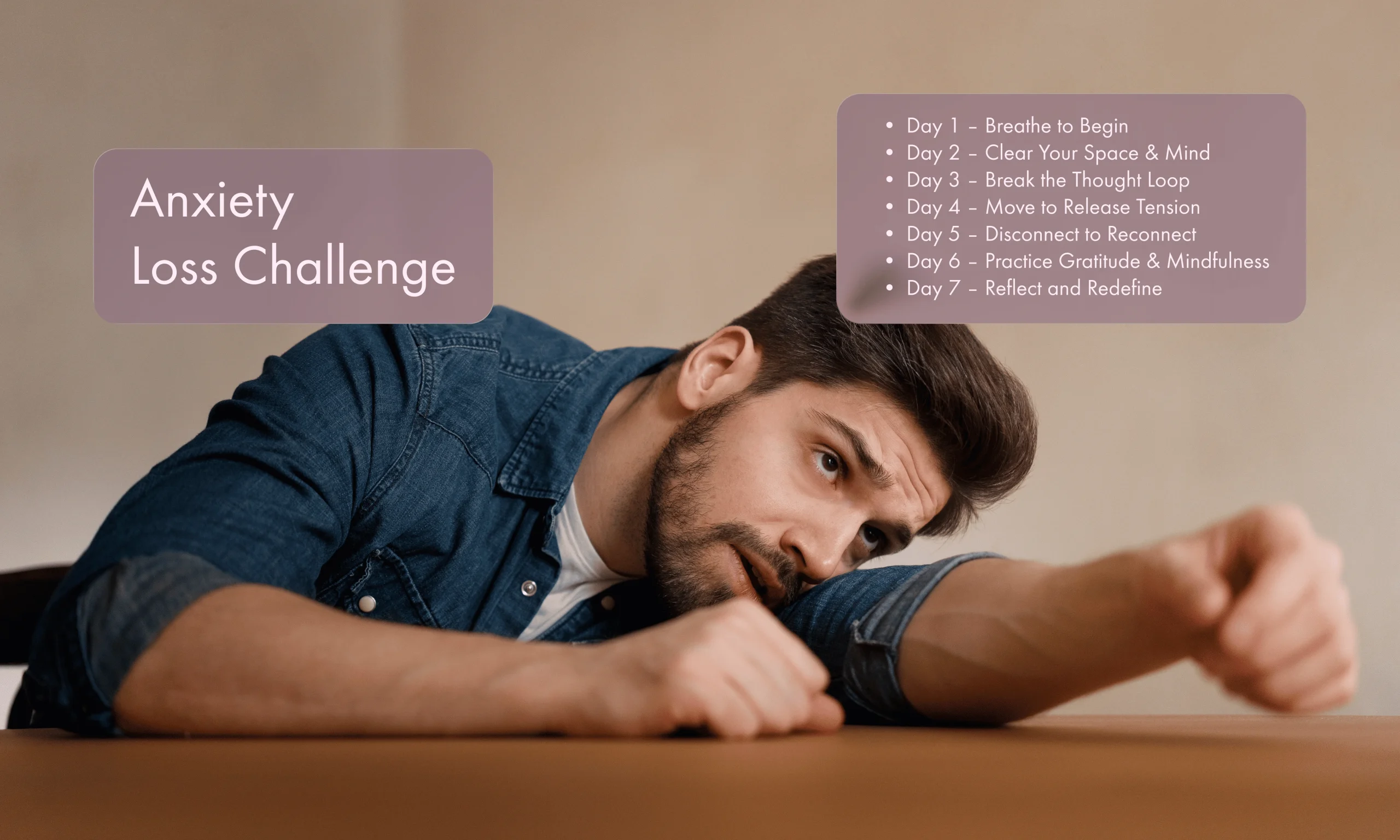
The Anxiety Loss Challenge is a simple yet powerful way to reset your mind using small, consistent actions. Instead of trying to fix everything at once, this approach focuses on one step at a time. Over seven days, you slowly train your mind and body to move away from stress and toward calmness.

This 7-Day Anxiety Reduction Plan is designed to help you build awareness, break negative patterns, and create habits that support emotional balance. It is not about perfection but about progress and consistency.

Anxiety Loss Challenge

The Anxiety Loss Challenge is built on the idea that small daily changes can have a big impact. Anxiety often builds up through repeated thoughts and stress responses, but it can also be reduced through intentional habits.
Anxiety Loss Challenge

By following this structured plan, you begin to understand how anxiety and physical health are connected. Over time, this awareness helps you respond better to stress and improves both mental and physical well-being.

Day 1 – Breathe to Begin

The first step in the Anxiety Loss Challenge starts with your breath. Taking a few minutes to slow down your breathing can immediately calm your nervous system.

Practicing controlled breathing helps signal safety to your brain. This is especially helpful because anxiety and physical health are closely linked, and calming your body can directly reduce mental tension.

Day 2 – Clear Your Space & Mind

On the second day, focus on your environment. Cleaning a small space or reducing digital clutter can make a noticeable difference in how you feel.

A clear space often leads to a clearer mind. This step also highlights how anxiety disorders and physical health can be influenced by external surroundings and constant stimulation.

Day 3 – Break the Thought Loop

Day three is about awareness. Writing down your thoughts and questioning them helps you understand whether they are real or imagined.

This simple practice supports emotional clarity and is one of the most effective ways to reduce anxiety. When you start identifying patterns, you gain control over how you respond to them.

Day 4 – Move to Release Tension

Physical movement plays a powerful role in managing anxiety. Whether it is a walk, stretching, or dancing, movement helps release built-up stress.

This step also answers an important question many people have — how  anxiety and depression affect physical health. The body stores stress, and movement helps release it naturally.

Day 5 – Disconnect to Reconnect

Taking a break from screens can help your mind slow down. Constant notifications and digital overload often keep your brain in a state of alertness.

Spending time offline or in nature helps your system reset. It allows you to reconnect with yourself and reduces unnecessary mental stimulation.

Day 6 – Practice Gratitude & Mindfulness

Day six focuses on shifting your attention. Practicing gratitude helps you notice what is going well instead of focusing only on stress.

This is where mindfulness for anxiety becomes important. It helps you stay present and reduces the habit of worrying about the future.

Day 7 – Reflect and Redefine

The final day of the Anxiety Loss Challenge is about reflection. Looking back at your progress helps you understand what worked best for you.

This step is also about continuing the journey. Choose one habit that makes you feel better and carry it forward into your daily routine.

Also Read:7 Strategies to Beat the Fear of Failure in Life Without Self-Pressure

Conclusion

The Anxiety Loss Challenge shows that change does not have to be overwhelming. Small, consistent actions can help you reduce anxiety and feel more in control of your thoughts and emotions.

If you want to go deeper into understanding your patterns and transforming your mindset, The Game of Change by Geeta Ramakrishnan offers powerful insights into self-awareness and emotional growth. The book helps you shift from feeling stuck to feeling empowered in your everyday life.

If this journey resonates with you, you can grab your copy online and take the next step toward a calmer and more balanced life.

FAQs

Yes, anxiety can sometimes lead to weight gain due to stress eating or hormonal changes.

In some cases, anxiety may reduce appetite, leading to weight loss.

Yes, prolonged stress and anxiety can contribute to temporary hair loss.

Managing stress, eating small meals, and creating a routine can help improve appetite over time.

Filed Under: Emotions

  • Page 1
  • Page 2
  • Page 3
  • Interim pages omitted …
  • Page 10
  • Go to Next Page »
  • Facebook
  • Twitter
  • Instagram
  • LinkedIn
  • YouTube
  • Connect

Copyright © 2026 · Infinity Pro On Genesis Framework · WordPress · Log in