• Skip to main content

The Game of Change

Geeta Ramakrishnan

  • About
  • Work With Me
  • Media
  • Book
  • Resources
    • Free
    • Premium
  • Blog
  • Connect

Geeta

Steps to Conquer Your Fear of Hurting Someone

March 2, 2026 By Geeta

Fear of Hurting Someone

The fear of hurting someone is irrational and mostly rooted in a desire for total controlLet’s explore this fear and its consequences through the perspective of Geeta Ramakrishnan, who is the author of the book “The Game of Change.”

What Is the Fear of Hurting Someone, and Why Does It Happen?

The fear of hurting someone is, in fact, a “misguided form of empathy.” Because we fear causing a negative emotional impact on others, we hesitate to speak the truth or set boundaries. However, This kind of fear can become a restriction on our freedom.

There are many reasons behind this phobia of hurting someone’s feelings:

  • From a young age, we are taught that being good means making others happy. It indicates that we have done something wrong if someone else is hurt by our actions.
  • We feel that we are the ones responsible for the reactions of others. But this is untrue because other people are responsible for their own emotional processing.
  • Because of our fear of hurting someone, we choose compliance or silence to avoid messy conversations with others.
  • We wrongly assume that “hurting others” is a bigger sin compared to “hurting ourselves.”

How Fear of Hurting Others Slowly Hurts You

Being considerate of others’ feelings is, in fact, a virtue. However, an obsessive fear of hurting someone’s feelings is one of the many kinds of self-sabotaging behaviors. This causes an “erosion of identity.” As a result, we become a “chameleon,” where we keep shifting to please others’ expectations.

We feel stressed and anxious all the time because we constantly have to suppress our feelings and desires. The phobia of hurting someone’s feelings often results in us being caught in a trap of resentment. We also suffer from a feeling of stunted personal growth because of this fear.

The Real Shift: From People-Pleasing to Personal Responsibility

To shift from our people-pleasing behavior to personal responsibility, we must stick to the following rules:

Taking Emotional Ownership:

We might be responsible for our own actions and kindness towards others, but we are not responsible for the happiness or internal reactions of others. By realizing this, we can escape the fear of hurting someone.

Developing More Honest Connections:

Taking personal responsibility for being our true selves is important. By being brave enough to express our true feelings to others, we can build deeper and more honest relationships with those around us and avoid the fear of hurting someone phobia.

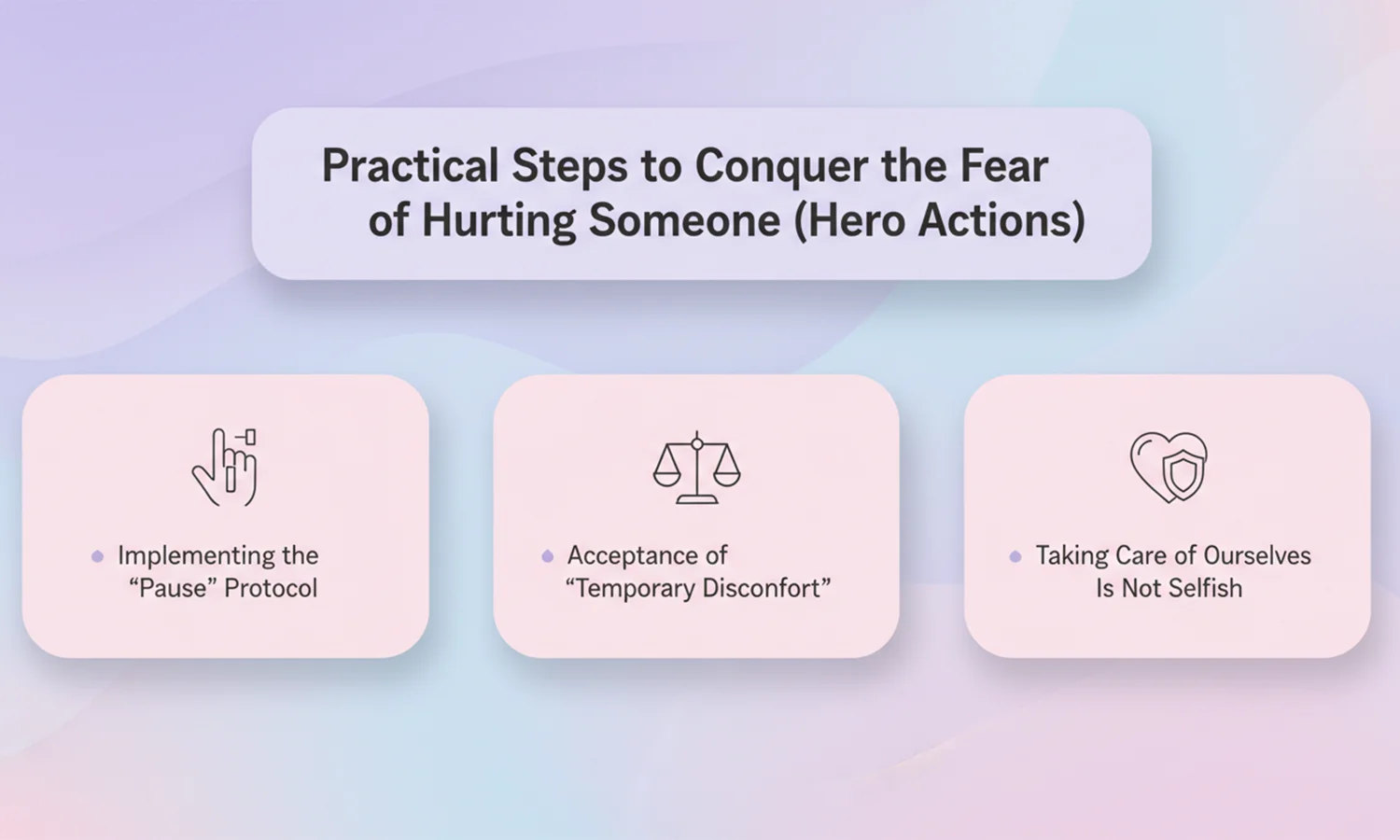
Practical Steps to Conquer the Fear of Hurting Someone (Hero Actions)
Fear of Hurting Someone

To conquer the fear of hurting others, it’s imperative that we transition from the passive “victim” thinking mode to the proactive “hero” mode. This can be achieved through the following steps:

1. Implementing the “Pause” Protocol

Before we say “yes” to a request out of guilt, we must implement a mandatory pause. The heroic action here is to detach our immediate emotional response (fear of rejection) from our logical capacity. 

It’s better to tell the other person, “I need to check my schedule and get back to you.” This will create the space necessary to evaluate if you are acting out of choice or compulsion.

2. Acceptance of “Temporary Discomfort”

The fear of hurting someone is usually just a fear of our own discomfort with their reaction. A key hero action is to sit with the awkwardness.

When you set a boundary, and the other person looks disappointed, it would be wise to resist the urge to “fix” it. Remind yourself that their disappointment is a natural emotion they are capable of handling.

3. Taking Care of Ourselves is Not Selfish

Your mindset should be “taking care of yourself isn’t selfish; it’s a prerequisite for being a high-functioning human.”

The hero action here is to schedule “Me-Time” as a non-negotiable appointment. When you honor this kind of commitment to yourself, you build the “muscle memory” of self-respect, making it easier to say NO to others. And, your fear of hurting someone will gradually fade away!

Conclusion:

The phobia of hurting someone’s feelings is found among many of us. However, we can tackle this fear by following the instructions in the book, “The Game of Change” authored by Geeta Ramakrishnan.

FAQs

It’s not exactly a “clinical” phobia, but more of an emotional anxiety rooted in social conditioning.

The fear of being rude keeps us trapped in dishonesty, but true honesty is actually the highest form of respect. Once we understand this, we can become honest without being rude.

Dystychiphobia is a psychological barrier to personal growth and happiness. It’s actually the fear of accidents or misfortune that prevents an individual from taking the steps to change their lives for the better. 
Filed Under: Emotions

7 Strategies to Beat the Fear of Failure in Life Without Self-Pressure

February 27, 2026 By Geeta

Fear of Failure

What Is Fear of Failure and Why Does It Happen?

The fear of failure is a deep worry about making mistakes or not meeting expectations. Many people experience it at some point, especially in school, work, or relationships. But when this fear starts controlling your decisions, it can stop you from trying new things or taking healthy risks.

Psychologists describe being afraid of failure as a response to shame, criticism, or past negative experiences. It often develops in childhood environments where mistakes were punished or where success was expected at all times.

Common reasons for fear and failure anxiety include:

  • Perfectionist thinking
  • Fear of judgment from others
  • Low self-esteem
  • Past embarrassing experiences
  • A belief that mistakes define your worth

When left unchecked, this fear can grow into avoidance, procrastination, and self-doubt.

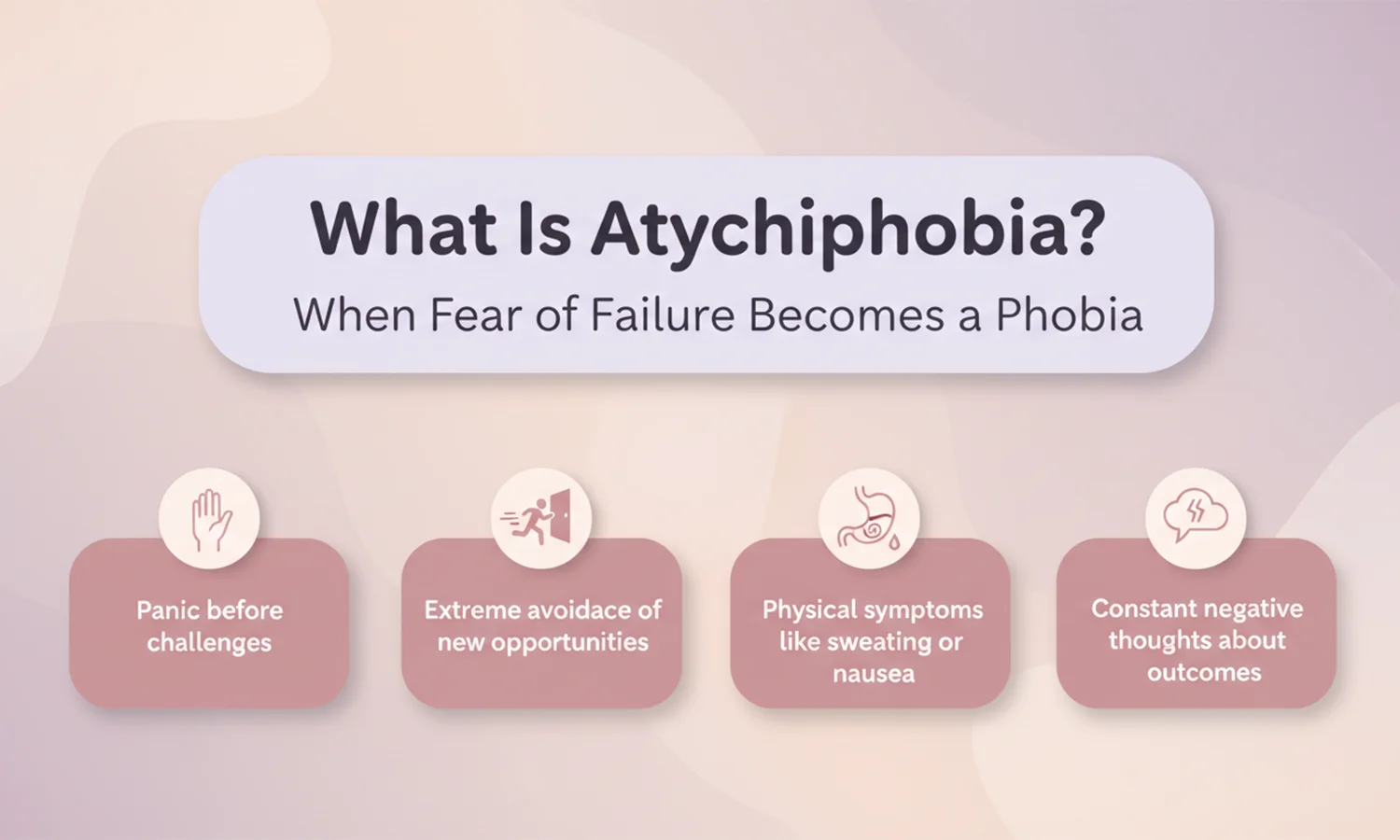
What Is Atychiphobia? When Fear of Failure Becomes a Phobia

 Fear of Failure

In some cases, the fear of failure becomes so intense that it turns into a clinical condition called Atychiphobia. This is a severe form of fear of failure phobia, where a person avoids tasks simply because they might not succeed.

Unlike normal nervousness, Atychiphobia causes:

  • Panic before challenges
  • Extreme avoidance of new opportunities
  • Physical symptoms like sweating or nausea
  • Constant negative thoughts about outcomes

People with this condition may spend months or years avoiding goals. In such cases, professional support can help in overcoming the fear of failure through therapy and guided exercises.

Signs That You Are Afraid of Failing in Life

Many people are afraid of failing without even realizing it. The fear often shows up in daily habits rather than dramatic panic.

Here are some common signs:

  • Chronic procrastination before important tasks.
  • Refusing to try new things.
  • Overthinking simple decisions.
  • Negative self-talk like “I’m not good enough”.
  • Only choosing tasks where success feels guaranteed.

If these patterns feel familiar, you may be dealing with a strong fear of failure that is holding you back.

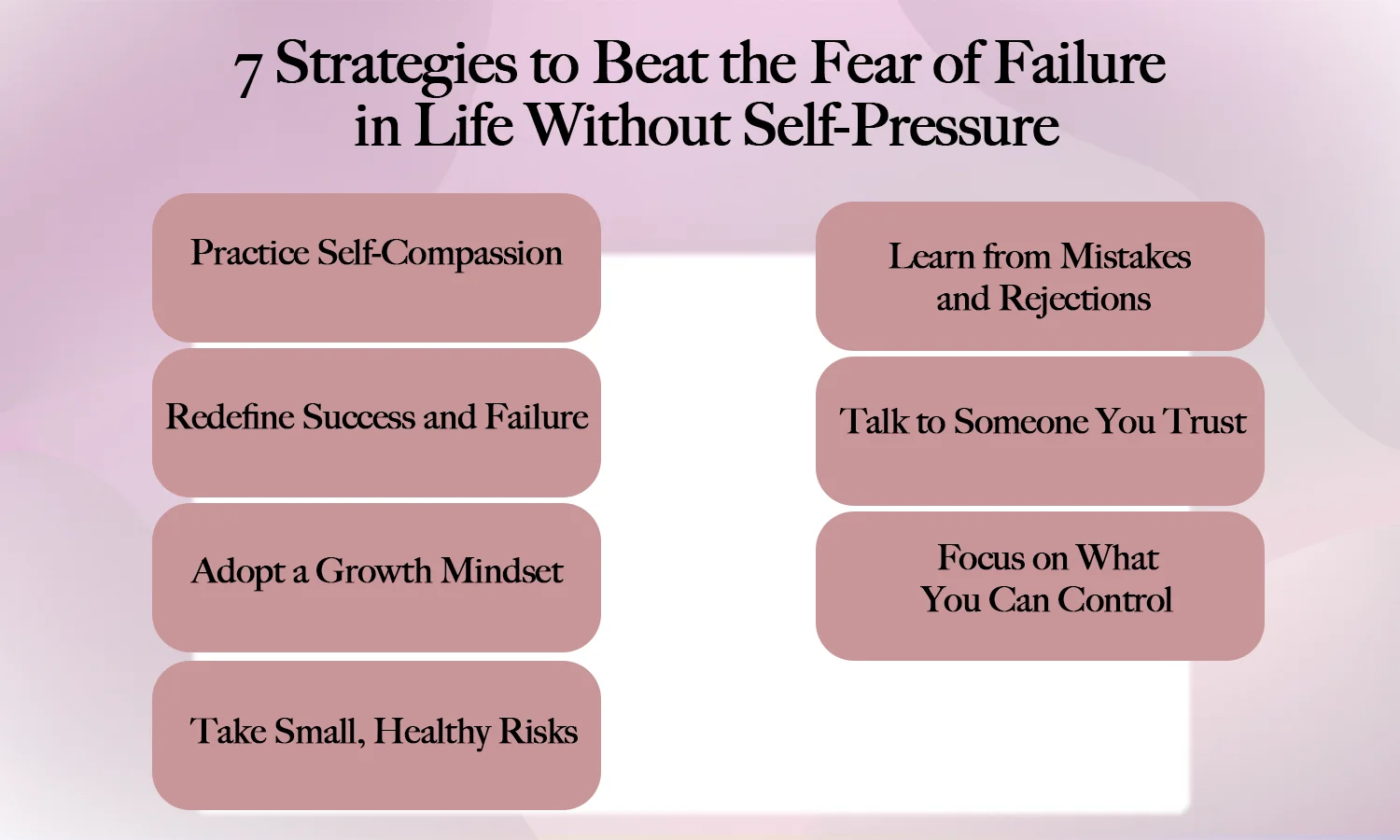
7 Strategies to Beat the Fear of Failure in Life Without Self-Pressure

 Fear of Failure

Overcoming the fear of failure does not require harsh discipline or constant self-criticism. Gentle, steady changes in mindset can make a big difference.

1. Practice Self-Compassion

Treat yourself with the same kindness you would offer a friend. Everyone makes mistakes, and setbacks are part of being human.

2. Redefine Success and Failure

Instead of chasing perfect outcomes, measure success by effort, learning, and growth. This helps you conquer fear of failure by removing all-or-nothing thinking.

3. Adopt a Growth Mindset

Believe that skills can improve with practice. When you see mistakes as lessons, the fear of failure begins to lose its power.

4. Take Small, Healthy Risks

Break big goals into small steps. Each small success builds confidence and reduces anxiety.

5. Learn from Mistakes and Rejections

Ask yourself:

  • What did I learn?
  • What can I do differently next time?

This approach helps you to overcome the fear of failure by turning setbacks into useful feedback.

6. Talk to Someone You Trust

Sharing your worries with a friend, mentor, or therapist can give you clarity and support.

7. Focus on What You Can Control

Put your energy into effort, preparation, and attitude instead of worrying about the final result. This reduces pressure and helps you move forward.

Ready to Take the Next Step?

Living with a constant fear of failure can feel exhausting, but it does not have to control your life. By practicing self-compassion, taking small risks, and focusing on growth instead of perfection, you can build confidence step by step.

The goal is not to eliminate mistakes but to change how you respond to them. When you learn to see failure as part of the journey, success becomes less stressful and more meaningful.

Key Takeaways

  • The fear of failure often comes from perfectionism, past criticism, or low self-esteem.
  • In severe cases, it can develop into Atychiphobia.
  • Signs include procrastination, avoidance, and negative self-talk.
  • Gentle mindset shifts can reduce anxiety around failure.
  • Small, consistent actions help build confidence over time.

FAQs

To reduce overthinking, focus on actions instead of outcomes. The fear of failure grows when you imagine worst-case scenarios. Break tasks into small steps and complete one step at a time.

Start by challenging negative thoughts and replacing them with realistic ones. Regular practice, journaling, and small risks help reduce the fear of failure over time.

Low self-esteem often comes from repeated criticism, comparison, or past failures. When the fear of failure becomes part of your self-image, it can lower confidence and stop you from trying new things.

Filed Under: Emotions

How to Deal With Fear: Simple Techniques to Calm Your Mind

February 26, 2026 By Geeta

how to deal with fear

How Fear Affects the Mind and Body

Before you know it, your year has come to an end. You look back at the highs and lows, cherish the highlights and move on to the next year, set a bunch of resolutions that you may or not follow and get ready for the new year.

When fear is triggered, the body activates the fight-or-flight response. Your heart rate increases, breathing becomes faster, and muscles tighten.

On the mental side, fear narrows your focus. The brain shifts attention to the perceived danger and reduces logical thinking. This is why anxiety can make even small problems feel overwhelming. 

Learning how to deal with fear and anxiety is important because it helps your body return to a calm, balanced state.

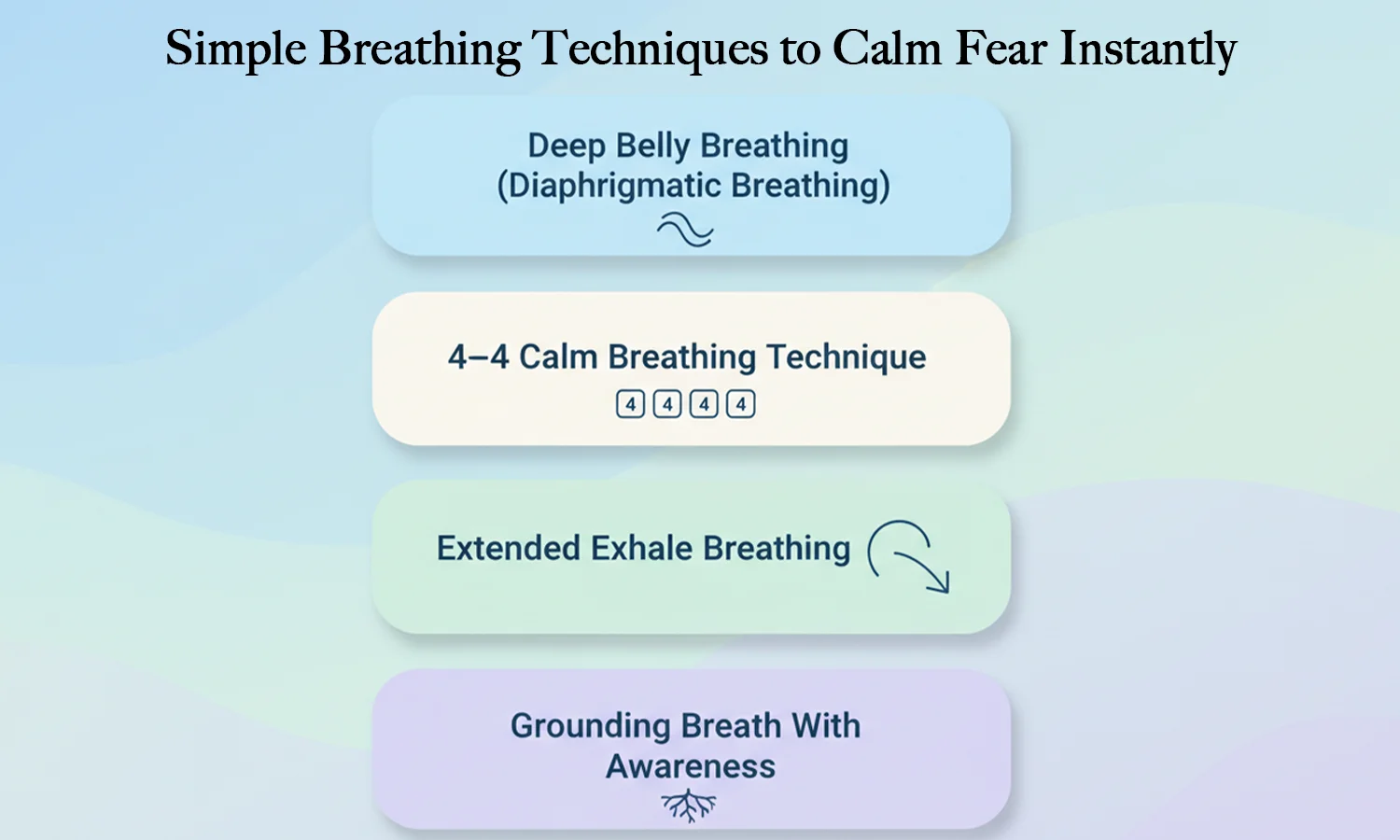
Simple Breathing Techniques to Calm Fear Instantly

how to deal with fear

One of the fastest ways to learn how to deal with fear is through breathing exercises. Controlled breathing signals the brain that you are safe and helps slow your heart rate.

Deep Belly Breathing (Diaphragmatic Breathing)

Deep belly breathing is a simple technique that activates the body’s relaxation response. Sit or lie down comfortably. Place one hand on your chest and the other on your stomach. Breathe in slowly through your nose and feel your stomach rise. Then exhale gently through your mouth. 

4–4 Calm Breathing Technique

The 4–4 method is easy to remember and can be done anywhere. Inhale through your nose for a count of four. Then exhale for a count of four. Continue this rhythm for several cycles. Equal breathing balances your nervous system and helps you focus on the present moment instead of fearful thoughts.

Extended Exhale Breathing

This method focuses on longer exhalations. Inhale quietly for four seconds, then exhale slowly for six to eight seconds. A longer exhale tells your body to relax. It slows the heart rate and helps you regain control when fear rises suddenly.

Grounding Breath With Awareness

Grounding breathing combines deep breathing with awareness of your surroundings. Sit comfortably and focus on the feeling of your feet touching the floor. Notice your breath moving in and out. If your thoughts wander, gently return your attention to your breath, which reduces anxiety.

Replacing Fear-Based Reactions With Conscious Choices

how to deal with fear

Another important part of learning how to deal with fear is changing your reaction patterns. Fear often causes automatic responses, like avoiding a task or overreacting to a situation.

Pause:

When fear appears, take one slow breath and create a small mental break.

Process:

 Acknowledge the feeling by saying, “I am feeling fear right now.” Naming the emotion helps calm the brain.

Proceed:

Choose a small action that aligns with your goals. This could be making a phone call, starting a task, or asking for help.

This method gradually teaches the brain how to overcome fear by replacing automatic reactions with thoughtful decisions. It is also useful for specific worries, such as how to deal with fear of failure.

Daily Habits That Reduce Fear Naturally

Learning how to deal with fear is easier when your daily routine supports calmness and stability.

A regular sleep schedule helps regulate emotional responses. Gentle morning routines, like stretching or quiet reflection, prepare the mind for the day. Physical activity, such as walking or yoga, releases natural mood-boosting chemicals in the brain.

Balanced meals also help stabilize energy levels. Too much caffeine or irregular eating can increase anxiety symptoms.  Small daily practices, such as gratitude journaling or gradual exposure to fears, build confidence over time. These habits slowly reduce fear and create a stronger sense of emotional stability.

When Fear Stops Controlling You, Change Begins!

Once you understand how to deal with fear, you begin to see it differently. Fear is not always a sign to stop. Sometimes it is a signal that something important is ahead.

You do not need to be completely fearless to take action. Even a small step forward builds confidence. Each time you act despite fear, your brain learns that you are capable of handling challenges.

Conclusion

Knowing how to deal with fear can change the way you approach challenges in life . If you feel stuck and need more personal guidance, structured support can make a big difference. At Coaching with Geeta, you can find practical tools, mindset techniques, and one-on-one coaching that help you understand your fears and move forward with confidence. 

Key Takeaways

  • Learning how to deal with fear starts with understanding how it affects your body and mind.
  • Breathing techniques can calm fear within minutes.
  • choices help replace automatic fear-based reactions.
  • Healthy daily habits reduce long-term anxiety.

FAQs

Techniques like deep belly breathing or extended exhale breathing help regulate your heart rate. They help in learning how to deal with fear in stressful moments.

No, fear is a natural human response. It is part of the body’s survival system. Understanding how to deal with fear helps you turn it into a signal for growth rather than something to avoid.

You can manage fear naturally through breathing exercises, regular physical activity, good sleep, and mindful practices, helping you emotional balance and how to deal with fear without relying on medication.

Fear can appear suddenly because the brain reacts to perceived threats, not just real ones. Stress, lack of sleep, or negative thoughts can trigger this response. Learning how to deal with fear helps you calm these reactions more quickly.

Filed Under: Emotions

Audit Your Life, Be Your Own Boss

December 6, 2021 By Geeta

Before you know it, your year has come to an end. You look back at the highs and lows, cherish the highlights and move on to the next year, set a bunch of resolutions that you may or not follow and get ready for the new year.

However, do you really take a minute to really sit back and assess the changes, along with what went well and what didn’t? Conducting a life audit is how you can ensure that your growth, be it personal, emotional, or professional is going on the right track and you are able to deal with changes in your environment.

The word audit might sound complicated, but it’s really not. All it takes is taking a few minutes at the end of the day and mentally assessing your wins and losses. No matter how small it be, learning from each activity you are doing or interaction you have with someone else, can really bring about a change in yourself.

You might be wondering if you even need a life audit and the answer to that question is always yes. The main purpose of conducting a life audit is to ensure that you are conscious of how you are growing, as a person. To constantly keep learning and extracting value from your interactions, is how can better yourself in the journey of life and improve your wellness. After all, learning doesn’t end at just the classroom.

Yes, this might seem to be a bit of a task at first, so, you can take the help of a journal. Draw a few columns for the different parts of your life: family and friends, work, mental health, physical fitness. Now write down notes about how you feel about these separate sections. Ask yourself questions like- have I been able to dedicate enough time to nurture this, how do I feel about this right now, how can I better spend my time and energy towards this?

You may have to remind yourself to do this at first, and might even dread it at times, because checking in with yourself means confronting some uncomfortable thoughts that you may be trying to avoid. However, after a few weeks of checking in with yourself, you will find this process to be therapeutic and might even look forward to it!

Here are some tips below to help you with becoming a pro at auditing your life:

Finding a peaceful space to conduct your life audit:

To be able to listen to your inner thoughts, you need to be able to be in a place where you can think in peace. Choose a quiet corner of your house, or if that is not possible, find a way to tune out external noise or distractions. You can do this by plugging in your earphones and listening to some calming tunes or just try to switch off your mobile phone for fifteen minutes at the end of the day so you can have a mini-digital detox and begin your self-assessment. https://www.forbes.com/sites/bryanrobinson/2020/08/04/listen-to-your-body-talk-and-quiet-your-mind-with-5-minute-mindfulness-microchillers/?sh=32c804f52dab

Choose a journal that you are comfortable with using:

To make conducting a regular life audit a habit, writing down your thoughts will always help. If not always, at least in the beginning. If you feel like you aren’t able to get a hold on your thoughts and emotions because you simply don’t have the time to, journaling is the best way to gain back that lost control. The benefits of writing down your thoughts are simply endless: https://theadroitjournal.org/2020/04/03/the-benefits-of-writing-down-your-thoughts-and-feelings/

Ask the right questions:

Not every part of your life can be dealt with by asking the same generic questions. When conducting a self-inquiry, it’s better if you go all in and tackle the issue at hand by confronting your uncomfortable thoughts head on. Ask yourself what exactly went wrong, how can you make it better, how can you regain control of the situation; how can you nurture this by managing your time and efforts efficiently. At the same time, it’s important to assess your wins too, just because you had a win, that’s no reason to not learn from it. Inquiring things like, how it made you feel and how you can change to make it happen again is something you can strive to do. For some help in this regard, here are some questions you can check out: https://www.inc.com/wanda-thibodeaux/34-essential-life-audit-questions-you-cant-afford-.html

If you need some more tips on how, feel free to check out this link below: https://www.coaching-online.org/life-audit/ Now, you are completely equipped to conduct a life audit of your own. Remember, don’t be too hard on yourself, just try at first!

Filed Under: Zen Success

Move on – Let Your Past Go and it May Never Define You

November 9, 2021 By Geeta

One thing we must always remember is that experience builds us to be better, hopefully not the other way around. As life is just like a roller coaster of ups and downs, no one stays on top or down under if you know what I mean. Good and bad days will always come, and it’s up to you how you will learn from it and step up to the challenge.

It is hard to go on with life when we cling so much to the past.

The past is something that is finished, and it is now just a memory that you will always have whether you like it or not.

That means you need to leave it all in the past, too. Those that made you who you are right now, but that is not who you will be in the future.

Live in the now

Being happy is a matter of choice and the key to having a great life is to forgive yourself and leaving yesterday in the past as a finished chapter in the book of you.

When you achieved this part, only then you will be ready to have great relationships and life will start to become easier.

I once coached my friend Sonia who couldn’t seem to forgive someone from her past. I simply told her; how can you love the newcomers if you are still holding on to an old story? Since most likely, everyone else has moved on, so, it is your time now to say, “It’s about time, I am ready to start a new chapter.”

You can read more helpful guide from this story: Healing from the Past and Living in Your Present

Failures are opportunities to learn and grow – embrace it. They are designed to teach and make us stronger, better, kinder, tougher and more wonderful than we are in the present.

This is one of the ways we grow. This is how we move forward.

Check out my page, to equip you more in the day to day challenges of our lives.

Filed Under: Emotions

Acknowledge what matters, keep the rest secondary

November 2, 2021 By Geeta

There are thousands if not millions of different daily encounters in our lives and not all these things are pleasing enough to even recall, you would agree. It could be that primary teacher who did nothing but scold you every single day, because your school uniform doesn’t look as tidy as the rest of your classmates without her knowing the reason behind it – no one was present for you during those time to take care of the things you need for school because your parents needed to leave the house too early for work – and through the years, this has impacted your life in a negative way, giving you less confidence in terms of presenting yourself with other people.

It’s unfortunate, I know. But it’s never too late to get yourself backed up and gain back that confidence you deserve in this world. 

First, you must define the things and the people that matter to you. Once you managed to do that, make sure that only this circle will have access to your inner emotions and self-growth. If one of them breaks the rule of your sanity, don’t be afraid to remove them from the list instantly.

What I’m saying here is that, if the person or circumstance is not in your circle that matters, do not let it affect you. Instead, walk away and ignore the negative things that they are causing you to save yourself from further trouble.

Learn from the things that trouble you and master your mind to get over them fast.

Prioritise yourself because no one else will and know that you are always enough.

Tips?

  1. Choose your circle – Your circle of friends defines you, so it would be best for you to select and keep the quality ones closer to you.
  2. Meditate regularly – One way to reflect and regulate the toxicity of life is through meditation, so make it a practice to have a quiet time for yourself that can train your mind to be calmer and ready for the challenges of the day.
  3. Learn from your mistakes – Always charge everything to experience, no matter how bad it was, there will always be learnings from it that can build a better you.
  4. Share what you have – Finding a purpose in life could be challenging if you don’t know about the basic good things you can do in life – to share what you have and bless others. This doesn’t mean a material thing, it can also be in the form of coaching, teaching and simply being there for your friend that can help them out.
  5. Be grateful – You can maybe all things bad but being grateful is key to lead you to your destination. As no woman is an island, one way or another people around you will help you in every aspect (big or small) of your life. Never forget them and acknowledge what has been given to you that led you for the better.

You can get more of these thought-inspiring pieces as you visit my page and grow more in peace.

Filed Under: Zen Success

Managing Your Energy as a Parent

October 18, 2021 By Geeta

In one of my previous blogs, I covered how being a perfect parent is a myth. Yet this is a constant struggle for parents. Bringing up a child is a huge responsibility. It takes a lot of commitment from prospective parents not just physically and monetarily but also emotionally. Even then as working or stay-at-home mothers we often find ourselves in a dilemma in understanding if we spend enough time with our kids. Being on the go all the time can take its toll and we find ourselves running out of batteries earlier than sleep time. This results in regularly feeling drained, overwhelmed and off-balance when it comes to raising your kids. This blog is for you to understand how you can channel in the right energies with patience, and perspective to be the parent you want to be. Read on further to understand how best you can manage your energy as a parent.

Do not believe all that you see

The fatigue that comes with parenthood is exactly opposite to what we see on social media and on glamorizing TV series. Seldom do people talk about the real struggles that they encounter and how they go about a tiring day with kids. Comparing yourselves to others will only result in disappointment and drain your energy rather than boost it. 

Leave your stress outside of the home

Keeping your professional and personal life separate is often not easy. However, it is advisable to keep work stress outside of the home. An effective way to do this is to briefly have a conversation with a colleague or relative before you get home to diffuse the situation.

Ask for help 

Despite this juggling, you should accept the fact that you help and support. Especially during stressful times, enrol the grandparents or friends to babysit your kid. It can give you, as a parent, some free time for each other, to gather your sometimes chaotic and fast-paced life. This allows you to be fully available as parents, where you are more fun to be with rather than be stressed and in an angry mood. I dedicate my Thursdays to spend time with my 1-year-old grandson as his parents use that time to run some errands and simply unwind during a busy week.  

Be 100% available

At times that you are present with your children, give them your 100% attention. By attending office calls during family time, you are unconsciously sending the message that they are less important to you, while ironically you are working for your family. The best parts of your childhood are not those expensive gifts your parents gave you; it is the time you spent together, the times you laughed and played together. Wouldn’t you want to give the same to your children?

Nutrition, exercise and fresh air

It is worth investing in your mental and physical wellbeing to give your body the right nourishment, appropriate exercises and hydration to keep your energy levels in check. You must always emit the right energy that will help partake in your kid’s growth journey.  

Lead by example

If your life is more organized and disciplined, your children learn by example. Co-create the rules and boundaries together, enrolling the children in the process. Define the consequences of breaking the rules. It need not be severe. Missing the weekend out or washing the dishes perhaps. And follow through with it. Playing board games or doing a barbeque together is a great family bonding exercise.

While some of the above require you to make a slight lifestyle change, here are some of the quick fixes that can see an adrenaline rush in your energy levels. Some examples are a cuddle, singing or playing music, meditation, mindfulness, prayer, breathing or deep relaxation and spending time in silence.  Balancing your professional and personal life can be challenging, but it’s essential. You can go through this link for some tips and inspiration.

Filed Under: Emotions

Five Feminine Leadership Traits to Cultivate a Growth Mindset

September 27, 2021 By Geeta

In the professional world, we witness the pressures women leaders have to go through to prove their leadership skills. An individual’s leadership abilities depend on her personal strengths and personality. As we are looking at ‘personal goals’ this month, our core focus will remain on how to nurture and cultivate leadership traits that are beneficial in both your personal and professional lives.

While a lot of what we do in our professional lives affects our personal lives and vice-versa, building a growth mindset will allow us to maintain a healthy balance as we juggle through life and leadership. 

Self-Belief

Believing in one’s self is extremely important for one to take on big responsibilities. Confidence is a belief to create a successful outcome through our actions. When we believe we are good we believe in the value we have to offer. For eg: When we are confident about participating with our kids in a dance competition at school or an important meeting at work, we are more likely to achieve great results. 

Resilience

Resilience is defined as the capacity to recover quickly and fully from an unforeseen circumstance. Women are believed to be more resilient than men. It is also true that we deal with several conflicting personal, professional and systemic challenges than our male counterparts. Owing to unique challenges and individual needs we master the art of building resilience making us susceptible to defy any encounters coming our way. 

Empathy

Women are more empathetic than men. Our empathetic nature allows us more room to build and nurture relationships from the point of view of our kids or peers. This gives us the freedom to evaluate every situation we have at home and the workplace and derive at suitable decisions. Every person is different and reacts differently to a particular situation. 

Adaptability

The need for adaptability hasn’t been more important than now. With the work and home dynamics changing rapidly, women are more bound to adapt to the situations to stay relevant and avoid stagnation. 

One of the ways to adapt naturally to any situation is to have an open mindset and the will to change. Emotional tolerance and spiritual guidance go a long way in changing the dynamics of the situation. For eg: if you have accustomed your mind to adapt to change it will take you lesser time to change from Plan A to Plan B in case of a failure in Plan A. 

Persuasiveness 

To make great strides in the way you achieve your personal goals, you have to remain persuasive. Giving up lightly is not an option. Circumstances may change and can work in your favour therefore, remaining persuasive and persistent always pays off. Have a follow-up and action plan ready and the key is to remain politely persuasive. 

As women, we are constantly developing an action plan that prepares us for unexpected times. Your leadership traits are defined as your ability to detect and respond to change(s) around you, no matter how unexpected or inconvenient. If you are looking for a coach to develop or polish a few leadership traits in yourself, book a coaching session with me!

Filed Under: Zen Success

  • « Go to Previous Page
  • Page 1
  • Page 2
  • Page 3
  • Page 4
  • Interim pages omitted …
  • Page 24
  • Go to Next Page »
  • Facebook
  • Twitter
  • Instagram
  • LinkedIn
  • YouTube
  • Connect

The information on this website is not intended to be a substitute for professional health or personal advice.
Always seek the advice of a qualified professional for medical conditions.


Copyright © 2026 · Geeta Ramakrishnan