https://youtu.be/Exr6Q67eGes
BLOG 6/52 : GROWTH MINDSET
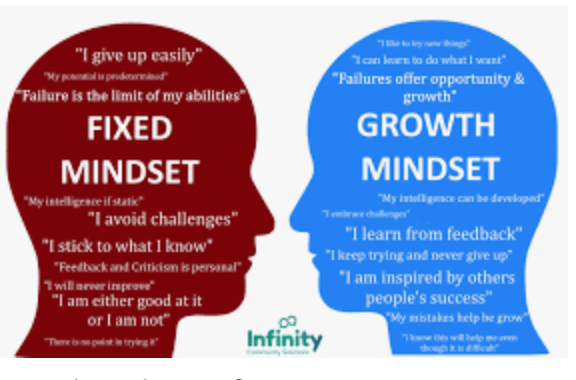
Dr Carol Dweck is a psychologist and studies people’s mindset. She
believes people have Fixed and Growth Mindset. People with Fixed Mindset feel that a person is born with an innate talent. This ’belief’ put a limitation to their growth potential and they tend to play the victim and can get resigned to their version of a fact.
Whereas a Growth Mindset is when you believe you can be as good as anyone in a skill and need the right input, focus, help and practice to achieve it. Once we adapt a Growth Mindset, the opportunities are limitless. It is also researched that learning by mistakes and from experiences stay stronger in our brains, rather than simply being told and following instructions blindly. Have you tried and allowed your children to experiment with and experience failure and learn from it? It helps them appreciate and aspire success in the long run. fear is our biggest stopper. What if they don’t learn? What if I try this and don’t succeed? Let me be safe and cautious and not speak, lest people will make fun of me. In-fact the ability to think out of the box, give your feedback or clear your thought-process with your boss, help you be a better achiever.
Blog 5/52 : How to change a Habit.
Blog 5/52 : How to change a Habit.
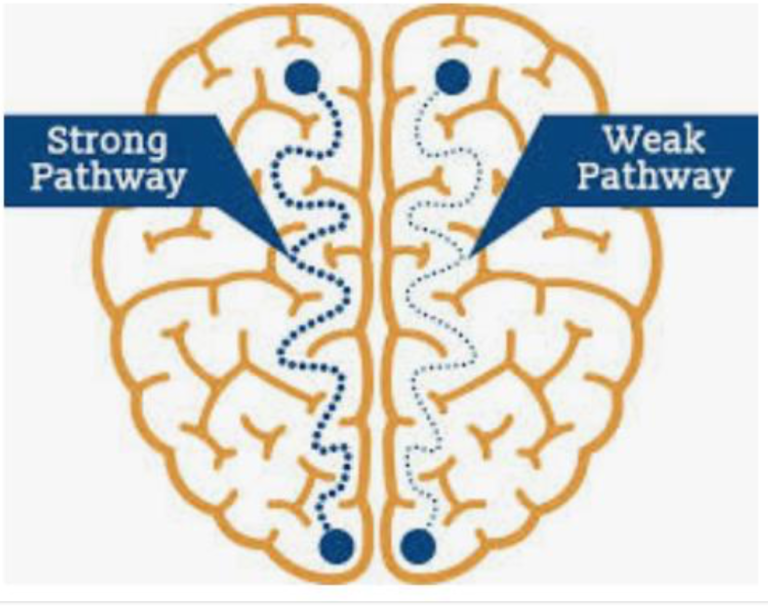
Neuroplasticity is the ability of the brain to change regardless of our age. We learn to walk when we are young by repeating over and over again the action of walking. In the beginning when we learn, we fall a hundred times. But we don’t give up till we are able to walk and run. Our brains reads each and every action of ours by forming a synaptic connection between the brain and the leg, as in this example. Over time and with practice, these connections become so strong that we need not voluntarily remember how to walk. It becomes an auto mode, a habit.
The synaptic connecting ability of the brain is a continuous process and keeps either strengthening by repetition, or can weaken and get deleted if not regularly practiced. If we stop walking for some reason, the connection between the brain and the leg weakens and can lead to the weakening of the leg muscles and it is possible that we can lose our confidence to walk. It implies that we can train our brain to forget any old habits that are not useful to us anymore, and replace it with new habits and learn new skills, no matter how old we are. Our brain is a muscle and like all muscles, the more we exercise the more fit it becomes. Regular training of this malleable brain muscle makes it stronger. It is for us to decide how we train our brain, reinforcing some old habits that work and practicing new things and useful ways of being till it become a habit to stay.
#thegameofchange #success
#Loveyourself

Women Fitness online : Feb 2020 issue
When I have asked people how they prioritize themselves, their work and their family, I often get this answer: Work, family and me. If you are playing an important pivotal role in your family and/or at work, doesn’t it make sense to focus first on ‘you’, to make you stronger, calmer, grounded person to be able to handle all the chaos and madness around you? Yes. It is counter-intuitive. You are so focused and pulled down by the stress in life that you have no time to breathe. As women, we tend to be natural givers and forget it is ok to receive as well. Listen to your body, give it a break once in a while and outsource help. Take time to look after your body. It could be in the form of exercise, healthy eating, taking time to groom yourself or taking that much-needed break even if it is over your children’s need. Meet friends for coffee and perhaps indulge in a guilt-free shopping spree.
Once you give time, space and energy to nurture yourself, your mind becomes calmer and more relaxed. This positive energy shows up in your body as well. You are better equipped to handle the stress around you, be it at home or in your office. Once you learn to love and respect yourself first, you metamorphize into a positive, happy and confident woman with an ability to give more, to your family, to friends and at work.
#Loveurself Because you are worth it
The importance of psychological well being for working women

MY ARTICLE FROM THE MAGAZINE: CANDY: FEB 2020 ISS
The importance of psychological well being for working women…
5 Key Skills you need for Workplace
Sharing my online article as it appeared in :Daily Brunch
Link: http://bit.ly/3aDYFsb
Climbing the rungs of a career ladder is more than just your qualifications. When someone receives an application for a new job, they tend to emphasise their hard skills more than anything else. They talk about the specific knowledge and ability they possess to execute that particular task. However, in the real world, no matter how good your skills are, you’ll cease to exist if you haven’t brushed up on your soft skills.
Though soft skills are difficult to measure or define, they are the interpersonal skills that will shape your ‘workplace well-being’. Today, companies too seek candidates that possess both types of skills when hiring for most positions.
Since it’s your workplace where you spend the maximum amount of your time, it’s important that you feel comfortable, secure, and happy.
To increase well-being at your workplace, there are tons of skills you can build. Though well-being is a subjective term, it usually emerges from your thoughts, experiences and actions on which you have control.
Whether it’s maintaining a work-life balance or finding your purpose, the skills you practice not only create a healthy work environment but also help you increase your performance to a significant level.
5 Skills that will help maintain your Well-being at Work
Given below are some skills that one can practise and comply with for well-being at their workplace:
Active Learning with a Growth Mind-set
Just as an equanimous mindset helps us function in the world a growth mind-set helps us deal with workplace pressures and difficulties. Once an employee develops a personal skillset, they look at work tensions as challenges to overcome rather than obstacles.
Active learning at a workplace is vital to promote the overall development of an employee’s growth. Academic studies reveal that performance improves when there is a growth mindset.
Creating a Supportive Environment
To thrive at your workplace, it is important to create a supportive, cohesive and encouraging work environment. For a team to deliver the best outcomes, every employee must develop great interpersonal skills with their teammates.
According to TLNT, 80 percent of workers agree that having the opportunity to learn new skills at work makes them more interested and engaged in their job. At the end of the day, supporting and uplifting others can spurt your personal growth.
Creative and Critical Thinking
To just do what you’re told at work is not always the right approach. As an employee, it is a must to interrogate instructions and processes. Life is all about maintaining a healthy balance. Instead of taking the logical route, evaluate the information available. As much as a logical quotient is important, allowing your critical thinking ability and letting your creative juices flow can help you improve processes, innovate in your field and spot pain points.
Rethinking the Value of Soft Skills
Soft skills are a broad term that is an amalgamation of social skills, communication skills, people skills and personality traits. In today’s workplace, it’s all about ‘survival of the fittest’. Working on each of these skills will help you interact better with your colleagues and maintain an overall peppy vibe at your workplace.
If you thought a job is all about ‘all work and no play’, you’re mistaken. Although business at work is important, getting a good hold on your soft skills will help you get through complex tasks with ease.
Celebrate and Share your Successes
A common reason most employees leave their jobs is that they do not feel appreciated. Whether it’s your first day at work, or you’ve been around for a while, you’re not expected to be perfect. Instead, look at yourself as ‘work-in-progress.
Thus, even if you achieve a small milestone, learn to celebrate it. A “pat” of appreciation will push you to do better and motivate you. Since a simple reward is fulfilling, rewarding and motivating, celebrating and sharing your success with teammates will only electrify your performance and encourage further growth.
Conclusion
Today, increasing importance is being placed on soft-skills. If you are looking to establish workplace well-being, it is important to develop and practice good soft skills that will influence the way you work, your interpersonal relationships, and your overall success.
Blog 4/52 Wear your Smile

Blog 4/52: Wear your Smile 🙂
Do you notice how you show up in the mornings? This mood lays a path of how you think and feel the rest of that day.
Sonia got up late, was caught up in a traffic jam and was late for her meeting. Her meeting did not go well. She was passing her irritable mood to her team and it did not help the situation.
What can you do if you were in Sonia’s place… Can you put on a big smile in your face. Try it out. Yes, you can fake it till you make it. Your brains will think you are happy when your facial muscles makes the impression of a ‘smile’. Just as your irritable energy is contagious, a smiley happy positive energy is equally contagious. People will be more relaxed around you and consequently this forms a good platform to creatively deal with any situation with more patience and acceptance.
5 Key Skills you need for Workplace

Portal: Nat 24 Link: http://bit.ly/38xwppw 21st Jan 2020
Your ability to climb the rungs of the career ladder hinges on more than just your qualifications. Though soft skills are the added talent that managers look for in candidates before hiring them. Although difficult to measure or define, they dictate your attitude and conduct that will shape your workplace well-being. Soft skills include any skill that can be classified as a personality trait or habit. Adaptability, ability to work in a team, creativity, leadership, conflict resolution and many more are all a part of soft skills. Interpersonal skills and effective communication are the more specific ones that many employers look for in candidates.
The ability to communicate involves knowing how to speak with others in different situations or settings. For instance, when working with a team on a project, you may find an idea or process ineffective and may need to communicate the same with your team. Finding a way to tactfully disagree with others on the job without creating conflict is an important skill that employers value.
Another example is that of adaptability. How easily do you adapt to changes? Changes in processes, environment, tools or clients you work with can happen quickly at work. Employees who are capable of adapting to new situations and ways of working are valuable in many jobs and industries.
Since your workplace is where you spend the maximum amount of your time, it’s important that you feel comfortable, secure, and happy. To increase well-being at your workplace, there are tonnes of skills you can build. Though well-being is a subjective term, it usually emerges from your thoughts, experiences, and actions on which you have control. Whether it’s maintaining a work-life balance or finding your purpose, the skills you practice not only create a healthy work environment but also help you increase your performance to a significant level.
5 Skills that will help maintain your well-being at work
Given below are some skills that one can practice for well-being at the workplace:
Active learning with a growth mindset
Just as an equanimous mindset helps us function smoothly in the world, a growth mind-set helps us perceive work tensions as challenges to overcome rather obstacles. The idea of personal growth at work helps us focus on finding solutions to problems rather than getting demotivated by them. The will to grow instils a positive attitude through constant motivation of keeping an eye on the end game.
Active learning at the workplace is vital to promote the overall development of an employee’s growth. Learning and developing skills that will enable you to navigate your ship through difficult waters is imperative to achieve growth.
Creating a supportive environment
To thrive at your workplace, it is important to create a supportive, cohesive and encouraging work environment. For a team to deliver the best outcomes, every employee must develop great interpersonal skills with their teammates.
A healthy environment is created by changing the culture of the company. Employee focus should be at the core of the organization by creating an environment that encourages showing gratitude to your team mates, eradicating negativity, exercising flexible work hours, team building exercises and open workspaces. A positive environment encourages commitment to excellence, open and honest communication, respect, compassion and empowerment. It also increases self-motivation, innovation and creative thinking which enable the organization to expand business, optimize quality and increase profitability.
According to a TLNT[A1] , 80 percent of workers agree that having the opportunity to learn new skills at work makes them more interested and engaged in their job. At the end of the day, supporting and uplifting others can spurt your personal growth.
Creative and critical thinking
To just do what you’re told at work is not always the right approach. As an employee, it is a must to interrogate instructions and processes. Life is all about maintaining a healthy balance. Instead of taking the logical route, evaluate the information available. As much as a logical quotient is important, allowing your critical thinking ability and letting your creative juices flow can help you improve processes, innovate in your field and spot pain points.
Using critical thinking while problem solving is an effective way to learn and progress. When your manager presents you with a particular problem and you immediately start looking for solutions. Ideally, you should take a step back and analyse the situation by researching and reviewing information. Interviewing the parties involved and coming up with more than one solution for the stated problem before coming to a conclusion is the way forward. This involves problem solving with critical thinking skills.
Celebrate and Share your Successes
A common reason most employees leave their jobs is that they do not feel appreciated. Whether it’s your first day at work, or you’ve been around for a while, you’re not expected to be perfect. Instead, look at yourself as ‘work-in-progress’.
Thus, even if you achieve a small milestone, learn to celebrate it. A “pat” of appreciation from yourself will push you to do better and motivate you.Since a simple reward is fulfilling, rewarding and motivating, celebrating and sharing your success with teammates will only electrify your performance and encourage further growth.
Importance of Soft Skills
Soft skills are a broad term for an amalgamation of social skills, communication skills, people skills and personality traits. In today’s workplace, it’s all about ‘survival of the fittest’. Working on each of these skills will help you interact better with your colleagues and maintain an overall happier vibe at your workplace.
If you thought a job is all about ‘all work and no play’, you’re mistaken. Although business at work is important, getting a good hold on your soft skills will help you get through complex tasks with ease.
Soft skills are incredibly essential to organisations across industries. In today’s constantly changing world, organizations need people who can adapt to new situations, apply their thinking and skills to evolve and develop new skills when the environment around them is constantly changing. If you are looking to establish workplace well-being, it is important to develop and practice good soft skills that will influence the way you work, your interpersonal relationships, and your overall success. No matter where you’re at in your career, you need soft skills to complete your everyday tasks effectively. They’re also extremely vital for promotions and career growth.